Delivering on Gartner’s Hybrid Mesh Firewall Framework

November 13, 2025
Hybrid work, hybrid clouds, and distributed enterprise architectures have made one thing clear: security can no longer be built around a single perimeter. Today’s networks span branches, multi-cloud workloads, data centers, and thousands of IoT and remote endpoints. Yet many organizations still operate siloed firewall architectures that weren’t designed for this reality — leaving them with fragmented visibility and inconsistent policy control.
Why Enterprises Need a Hybrid Mesh Firewall
According to Gartner’s Magic Quadrant for Hybrid Mesh Firewalls (August 2025), enterprises are rapidly shifting from isolated perimeter firewalls to hybrid mesh firewall architectures that unify policy, visibility, and threat prevention across physical, virtual, and cloud deployments.
Main factors driving this shift include:
- Hybrid complexity is the new norm – Organizations are moving to cloud, but most remain predominantly hybrid, forcing security teams to protect apps and data spread across multicloud and on-prem environments.
- Need for centralized visibility and control – Fragmented firewall deployments cause policy drift, inconsistent security enforcement, and complex troubleshooting.
- Expanding attack surface – AI-driven threats, SaaS adoption, supply chain integrations, containers, and IoT create security blind spots that traditional NGFWs (Next Generation Firewalls) can’t inspect or correlate.
- Operational fatigue and lack of skilled resources – Security teams struggle with firewall rule sprawl, misconfigurations, and firmware risks, demanding automated policy and risk management.
- Platform security adoption – Enterprises are consolidating point tools into modular security platforms to reduce cost and complexity—firewalls must now integrate, not operate alone.
- Open API and automation expectations – Customers expect modern security to be programmable and infrastructure-aware, delivered as code.
Traditional firewalls, struggle significantly in this context. For example:
- Multicloud inconsistency – A company running workloads across AWS, Azure, and on-prem VMware must define and manage separate firewall policies in each environment using different tools.
- Remote workforce security gaps – Traditional firewalls assume traffic goes through a corporate perimeter. With direct-to-cloud access and SaaS use, security enforcement must follow the user, not be tied to a branch firewall. Legacy NGFW architectures break here.
- Microservices and containers – East-west traffic inside Kubernetes or between microservices never touches a perimeter firewall, so legacy NGFWs have zero visibility or control inside modern application environments.
Gartner’s definition of a Hybrid Mesh Firewall
A Hybrid Mesh Firewall solves the weaknesses mentioned above. According to Gartner, a Hybrid Mesh Firewall (HMF) is a unified security architecture that replaces siloed, perimeter-based firewalls with a distributed enforcement model spanning data centers, branch sites, multicloud environments, micro-segmented networks, and remote users. It delivers a consistent security policy, centralized orchestration, and shared threat intelligence across heterogeneous environments using a cloud-based management plane. Unlike traditional NGFWs tied to static locations, HMFs support secure connectivity via IPsec, SSL VPN, and ZTNA while incorporating advanced threat detection, including DNS security, IoT/CPS device discovery, behavioral analytics, and risk scoring. A true HMF enables orchestration and automation at scale with zero-touch deployment, multicloud policy synchronization, AI-assisted troubleshooting, and APIs for integration and security-as-code automation. It consolidates visibility and control across hybrid deployments, integrates with IT and security ecosystems such as ITSM, SIEM, identity, and SASE/SSE, and leverages AI-driven threat correlation and prevention for faster, more adaptive protection.
Versa NGFW: full alignment with Gartner’s definition of hybrid mesh firewall
Versa NGFW fully aligns with Gartner’s Hybrid Mesh Firewall model by delivering centralized policy, distributed enforcement, and unified visibility across hybrid and multicloud environments. Versa provides a single-policy framework across branches, data centers, and multiple clouds, with AI-powered analytics for event correlation and anomaly detection. It delivers advanced threat prevention with IPS, SSL inspection, DLP, and DNS security while maintaining high performance. Available as hardware, virtual, or FWaaS, Versa applies consistent enforcement from edge to cloud and integrates with ITSM, SIEM, SOAR, and identity platforms through open APIs. With zero-trust segmentation and AI-driven threat correlation, Versa meets all the core requirements of a true Hybrid Mesh Firewall.
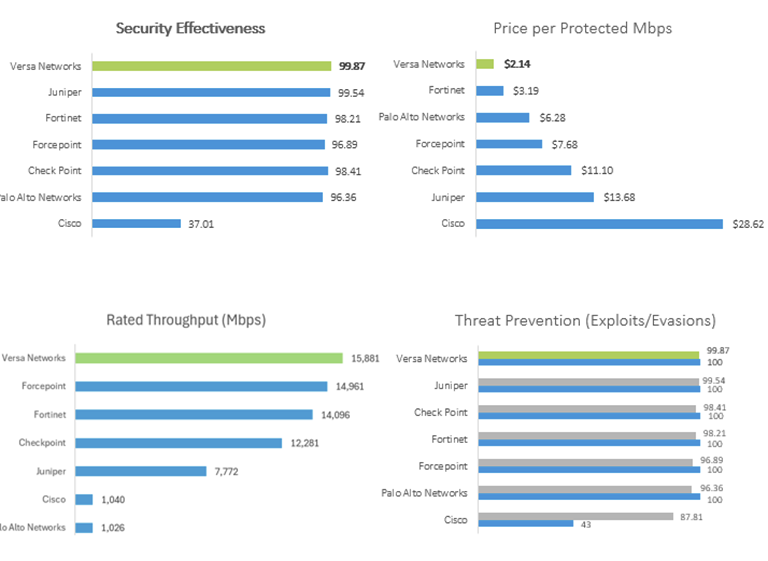
Figure: Versa outperforms all Tier-1 enterprise firewalls in security effectiveness, performance, threat prevention, and total cost of ownership – Source: Cyberratings
Why Network Security Leaders Choose Versa NGFW
For network security leaders, the real differentiator is not just whether a firewall stops threats — but whether it can do so everywhere the network lives, without multiplying complexity or cost. Versa NGFW delivers:
- Industry leadership: Versa outperforms all Tier-1 enterprise firewalls in four critical areas — security effectiveness, performance, threat prevention, and total cost of ownership — ensuring unmatched value and reliability
- Unified operations: Centralized management with API-based automation.
- Zero Trust enforcement: Policy-driven micro-segmentation for users, IoT, and applications.
- Operational efficiency: AI-driven insights for faster troubleshooting and smarter policy optimization.
- Regulatory assurance: Consistent, auditable policy enforcement across hybrid environments.
These outcomes align with Gartner’s central tenets of a hybrid mesh firewall: centralized visibility, orchestration, automation, and consistent cross-environment enforcement
Conclusion
As hybrid networks expand, customers expect their NGFW to deliver the visibility, consistency, and intelligence needed to secure every edge — physical or virtual. With unmatched performance, proven threat prevention, and the lowest total cost of ownership among Tier-1 firewalls, Versa sets the benchmark for next-generation protection in a hybrid mesh firewall world.
Subscribe to the Versa Blog
Recent Posts





The AI Memory Tax Makes uCPE Design Worth a Look
By Ponnaiyan PerumalOctober 8, 2026
Topics
Top Tags

Gartner Research Report
2026 Gartner® Magic Quadrant™ for SASE Platforms
Versa has for the fourth consecutive year been recognized in the 2026 Gartner Magic Quadrant for SASE Platforms1 and is one of only 12 vendors that met the criteria for inclusion based on the analysts’ evaluation of the VersaONE Universal SASE Platform.