Is Your Enterprise Network Ready for AI? Key Findings from EMA Research

August 7, 2025
As enterprises race to adopt artificial intelligence (AI), long-term successful integration may hinge on the readiness of their underlying network infrastructure. Recent research from IT consulting firm Enterprise Management Associates (EMA) reveals how early adopters are preparing their networks to support AI workloads the challenges they’re facing along the way. EMA’s report, “Readying Enterprise Networks for Artificial Intelligence,” surveys over 250 IT professionals across organizational levels to examine enterprise AI adoption strategies, security implications, and changing network requirements. Here are some of their key findings.
Enterprise AI Workloads Are Becoming Highly Distributed
By 2028, respondents believe AI workloads will be highly distributed. Training and inference will take place across private data centers, public cloud services, and edge computing environments. This distribution puts pressure on both data center (DC) and wide area network (WAN) infrastructure. Enterprises must ensure that these networks can handle the increased traffic, low latency, and security needs of AI.
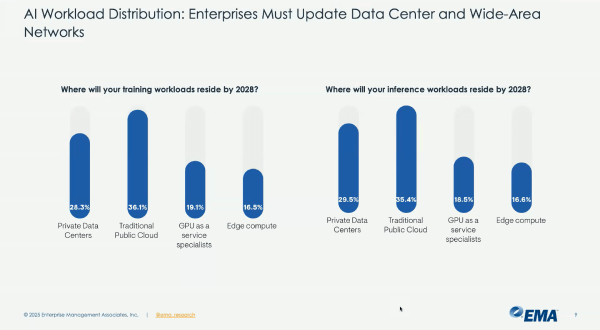
Currently, only 49% of enterprises say their DC networks are ready for AI traffic. WAN readiness is even lower, with 48% saying their WANs are prepared. The complexity of workload distribution, latency between sites, and traffic prioritization are major concerns
AI Network Challenges: Security Risks and Low Latency Requirements
According to EMA, the top business challenges enterprises face when adapting their networks for AI include security risks, budget limitations, and the difficulty of keeping pace with rapid AI innovation.
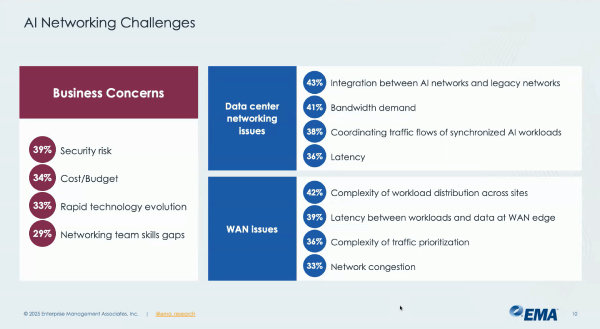
Cited by 39% of respondents, security remains the number one concern. Enterprises are especially worried about:
- Data privacy and compliance risks (60%)
- Vulnerabilities in AI APIs and third-party integrations (48%)
- Targeted attacks against AI models (47%)
- Data leakage (43%)
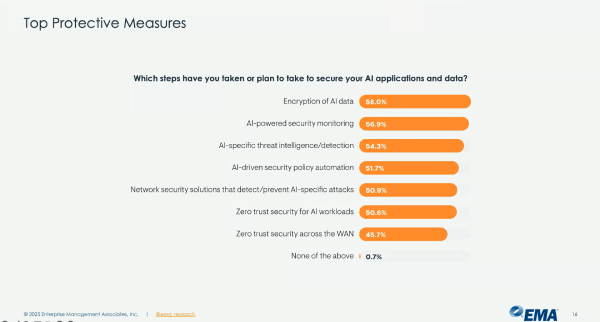
To this end, the great majority of organizations have already taken steps to secure AI applications and data, primarily through encrypting AI data and AI-powered security monitoring.
Latency is also a major issue, particularly in WAN environments. AI applications often require real-time data processing, and any delay can impact performance and outcomes. To reduce delays, 64% of enterprises are deploying AI workloads at the edge, closer to where data is generated and used.
SD-WAN and SASE Enable AI-Ready Networks
More than half (53%) of the organizations surveyed by EMA believe that SD-WAN and SASE architectures are essential for AI readiness. These technologies help improve performance and enforce consistent security policies for distributed AI workloads across locations.
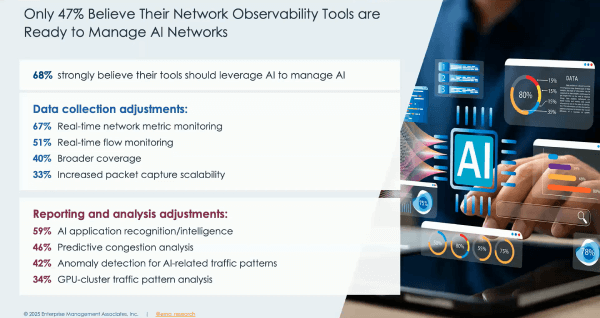
However, many enterprises believe there are still gaps in the visibility tools necessary to manage AI-related traffic effectively. Less than half of respondents feel confident that their current network observability solutions can meet the demands of AI. There is a need for more granular data collection, real-time end-to-end networking monitoring, predictive congestion analysis, and anomaly detection tailored to AI traffic patterns. There’s also growing interest in using AI to manage AI: 68% of respondents believe observability tools should leverage AI to better understand and control AI-driven traffic.
Modernizing Your Network for AI Success: Versa’s End-to-End Approach
AI is transforming how businesses operate, but its success depends on the strength and agility of the underlying network. EMA’s research makes it clear that enterprises must modernize their infrastructure for AI.
Versa directly addresses the challenges identified in EMA’s AI network readiness report by unifying networking, security, and observability into a single platform. As AI workloads become more distributed, Versa’s SD-WAN and SASE solutions support low-latency performance across cloud, data center, and edge environments. Built-in security features protect against AI-specific threats like model tampering and data leakage, while integrated Digital Experience Monitoring (DEM) provides the granular, real-time visibility enterprises need to manage AI traffic effectively. This end-to-end approach helps organizations meet the performance, security, and compliance demands of AI adoption.
To learn more about how leading organizations are preparing for AI success, we encourage you to read the full EMA research report. To learn more about how Versa is using AI in our own technology, see what we’re doing at Versa AI Labs.
Subscribe to the Versa Blog
Recent Posts

The AI Memory Tax Makes uCPE Design Worth a Look
By Ponnaiyan PerumalOctober 8, 2026


What Enterprises Really Want from SASE Consolidation
By Kevin SheuOctober 5, 2026
Topics
Top Tags
Gartner Research Report
2026 Gartner® Magic Quadrant™ for SASE Platforms
Versa has for the fourth consecutive year been recognized in the 2026 Gartner Magic Quadrant for SASE Platforms1 and is one of only 12 vendors that met the criteria for inclusion based on the analysts’ evaluation of the VersaONE Universal SASE Platform.