Introducing Versa Privileged Access Controls with Client-less ZTNA

May 20, 2026
Zero Trust Network Access (ZTNA) has become the standard architecture for securing private application access in distributed enterprises. Traditionally, most ZTNA implementations depend on endpoint agents installed on user devices to establish secure, policy-aware tunnels into enterprise environments. While this works well for managed corporate devices, it creates friction in scenarios where deploying an endpoint client is impractical—or simply undesirable.
Versa’s Client-less ZTNA addresses exactly this gap: delivering secure browser-based access to private applications without requiring software installation on the endpoint. This approach extends Zero Trust principles to unmanaged devices, contractors, third parties, and tightly controlled privileged access use cases, while preserving strong security controls.
Why Client-less Access Matters
Endpoint-based ZTNA clients provide rich telemetry such as device posture, OS health, certificate validation, and continuous session context. However, not every access scenario justifies installing an agent.
Versa identifies three primary situations where client-less ZTNA becomes essential:
1. BYOD and Unmanaged Devices
In many organizations, contractors, consultants, vendors, and temporary workers use personal or non-corporate devices. Installing enterprise security clients on such devices introduces several challenges:
- Privacy concerns from external users
- Limited administrative control over device environments
- High operational overhead for onboarding and support
- Difficulty maintaining software consistency across unknown endpoints
Client-less ZTNA removes this friction entirely by shifting secure access into the browser.
2. Restricted, Minimal-Trust User Access
Some users require access to only one or two narrowly scoped internal applications. In such cases, deploying a full ZTNA client may create disproportionate complexity relative to the access need.
Examples include:
- External auditors reviewing internal dashboards
- Short-term project contractors
- Partners accessing a single portal
- Temporary support vendors
- IT Administrators requiring to access systems temporarily for troubleshooting and maintenance
With browser-based access, organizations can grant precise least-privilege access without expanding endpoint trust unnecessarily.
3. High-Value Asset Protection
Sensitive systems—such as privileged admin consoles, SSH servers, RDP hosts, and regulated financial applications—often require tighter controls than standard application access.
Versa Client-less ZTNA enables organizations to:
- Restrict file uploads/downloads
- Limit clipboard interactions
- Prevent unauthorized session actions
- Hide sensitive application endpoints from public visibility
- Limit user accounts created on individual systems (like Switches, IOT devices)
This creates an additional defensive layer around critical infrastructure.
Privilege Access Controls Matters More in the AI-Driven Enterprise
As enterprises rapidly adopt AI-driven workflows, the nature of application access is changing—but not in a way that replaces traditional Zero Trust requirements.
AI initiatives are creating new access patterns such as:
- Temporary AI developers needing rapid access to internal model repositories
- Third-party data scientists requiring controlled access to sensitive datasets
- External contractors connecting to GPU clusters or AI training environments
- Privileged teams managing AI pipelines across hybrid cloud infrastructure
These users often operate from unmanaged or short-lived environments where deploying endpoint agents is impractical.
In this context, Privilege Access Controls based on client-less ZTNA becomes strategically important because it enables:
- Fast, browser-based onboarding for transient AI collaborators
- Secure access to sensitive AI infrastructure without expanding device trust
- Controlled exposure of high-value AI assets such as training servers and inference APIs
- Granular session restrictions around data movement and privileged actions
Versa is especially well suited here because its cloud-delivered architecture can broker secure access to both web and non-web AI resources—including SSH access to compute nodes, browser-based admin consoles, and private internal AI applications—without requiring endpoint software installation.
This makes Versa Privilege Access Controls highly aligned to modern AI operating models: dynamic, distributed, partner-driven, and security-sensitive.
How Versa Privilege Access Controls based on Clientless ZTNA Works
At a high level, Versa’s architecture replaces endpoint software with browser-mediated secure access via cloud-delivered ZTNA gateways.
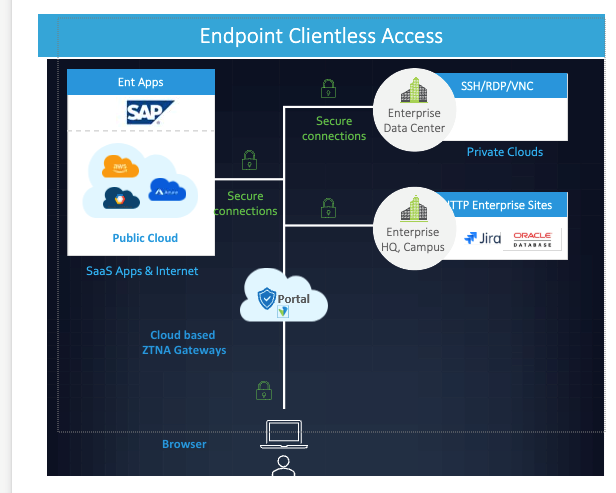
The access path includes:
- User browser initiates browser session with the Portal
- User authenticates via enterprise Identity Provider (IdP)
- Authorized applications (authorized specifically for the user) appear dynamically in portal
- User selects application widget
- Versa cloud gateway brokers secure connection
- Session is proxied into private enterprise resources
This architecture allows secure access to multiple application types, including:
- Web applications (HTTP/HTTPS)
- SSH sessions
- RDP desktops
- VNC remote systems
Unlike VPNs, users never gain network-level access. They only receive application-specific, identity-bound connections.
Browser-Based User Experience
The user journey is intentionally simple and frictionless.
Step 1: Access Portal
The user opens a browser and visits the enterprise access portal, such as:
No software installation is required.
Step 2: Identity Authentication
The user authenticates through the organization’s Identity Provider using existing SSO systems such as:
- Okta
- Azure AD
- Ping Identity
- OneLogin
This preserves centralized identity governance and MFA enforcement.
Step 3: Dynamic Application Presentation
Once authenticated, Versa displays only the applications authorized for that specific user. These applications appear as clickable widgets in a personalized access portal.
This dynamic filtering enforces:
- Role-based access control
- Identity-aware policy enforcement
- Reduced attack surface exposure
Unauthorized applications remain invisible.
Step 4: Secure Application Access
When the user clicks an application widget:
- HTTP apps open directly in browser
- Non-web apps (SSH/RDP/VNC) are brokered through Versa’s PAM subsystem
This enables rich remote access entirely inside the browser, without native client software.
PAM Subsystem for Non-Web Applications
Versa’s Privileged Access Controls also supports following protocols.SSH
- RDP
- VNC
Versa translates remote sessions into browser-rendered secure streams. This eliminates the need for local protocol clients while preserving centralized visibility and control.
Benefits include:
- Session isolation
- Auditability
- Browser-rendered privileged access
- Reduced credential exposure
This is especially valuable for administrators accessing infrastructure from unmanaged endpoints.
Security Advantages Over Traditional VPN
| Traditional VPN | Versa Client-less ZTNA |
|---|---|
| Network-level access | Application-level access only |
| Broad lateral movement risk | Zero implicit trust |
| Requires installed client | Browser-only access |
| Hard to segment access | Granular per-app policies |
| Large attack surface | Hidden application exposure |
| Unlimited access to application | Restricted actions on the application |
Because applications remain isolated behind Versa’s brokered gateways, internal infrastructure is never directly exposed to the internet.
Key Takeaway
Versa Client-less ZTNA extends Zero Trust principles to access scenarios where endpoint agents are impractical, unwanted, or unnecessary. In today’s AI-driven enterprise, where users, workloads, and collaborators are increasingly dynamic, that flexibility becomes even more valuable.
By combining browser-native simplicity with identity-driven access control, cloud-based secure gateways, and PAM-enabled remote session brokering, Versa delivers a scalable and elegant alternative to legacy VPNs and agent-heavy remote access models.
In a world where workforce boundaries are increasingly fluid—and AI projects demand secure but frictionless access—Client-less ZTNA is no longer optional. It is becoming foundational.
Subscribe to the Versa Blog
Recent Posts

The Essential Planes Every Sovereign SASE Vendor Must Support
By Anuj DutiaSeptember 17, 2026


Pervasive Security and Why the AI Era Needs a New Security Model
By Dhiraj SehgalSeptember 1, 2026

Topics
Top Tags
Gartner Research Report
2026 Gartner® Magic Quadrant™ for SASE Platforms
Versa has for the fourth consecutive year been recognized in the 2026 Gartner Magic Quadrant for SASE Platforms1 and is one of only 12 vendors that met the criteria for inclusion based on the analysts’ evaluation of the VersaONE Universal SASE Platform.