Secure Every Connection: Replacing VPNs with ZTNA to Protect Users, Data, and Applications Everywhere

December 11, 2025
Remote and hybrid work changed enterprise risk forever. The network is no longer a physical perimeter, yet traditional VPN architectures still operate as if it is. Once a VPN connection is granted, attackers gain broad access and freedom to move laterally with very few barriers. That exposure is no longer acceptable.
Organizations now operate with distributed workforces, SaaS adoption, and hybrid cloud environments. Legacy VPNs cannot keep up. Attackers exploit stolen credentials, unpatched gateways, and implicit trust to bypass defenses and reach high-value systems.
The Structural Risks of VPN Architectures
VPNs introduce inherent weaknesses that can be exploited.
- Stolen credentials unlock the entire network. A single compromised password becomes a master key.
- Internet-facing concentrators remain high-value ransomware targets and have been repeatedly exploited.
- Performance bottlenecks from centralized hair pinning degrade user experience and mask suspicious behavior.
- Operational fragility from constant patching, driver updates, and hardware scaling impacts resilience.
Modern access needs consistent Zero Trust security across cloud, data center, and branch — enforced at application-level granularity and continuously validated.
Selecting Right ZTNA Architecture
Many ZTNA solutions focus only on initial access decisions and lack the inline inspection or segmentation needed to stop advanced threats.
Enterprises need ZTNA that:
- Continuously verifies identity and device posture
- Limits access to individual applications rather than the full network
- Inspects every session to detect and block malicious activity
- Operates through a unified architecture without multiple control points
A Zero Trust approach must protect users wherever they are, not just broker connections.
Versa’s Unified Approach to Zero Trust Access
Versa Zero Trust Network Access is delivered through a unified SASE platform where connectivity and security are architected together. This removes the need to bolt on inspection or maintain separate cloud brokers.
Versa enforces identity, user posture, device posture, and context-based access to specific applications with full inline threat prevention and deep visibility. Traffic is secured using standards-based TLS/DTLS/IPsec and tunneled directly to Versa gateways from endpoints or data center VNFs, enabling inline inspection without additional infrastructure with following:
- Single Component Design
Versa’s firewall itself functions as both gateway and connector. This simplification reduces ,network impact during implementation of ZTNA, reduces OPEX and eliminates connector bottlenecks. - Hop-by-Hop Encryption with Standards
Instead of end-to-end proprietary tunnels, Versa leverages standards-based TLS/IPsec with hop-by-hop encryption. This enables traffic inspection at each gateway hop without breaking security, allowing inline enforcement of advanced services like IDS/IPS, DLP, CASB, SWG, and UEBA. The additional benefits of using standards-based approach are it makes the architecture more resilient and secure. - Performance and Routing Intelligence
Integrated firewall and routing intelligence enable Versa to optimize traffic paths, avoid choke points, and deliver consistent application performance. This reduces latency and enhances user experience for distributed organizations.
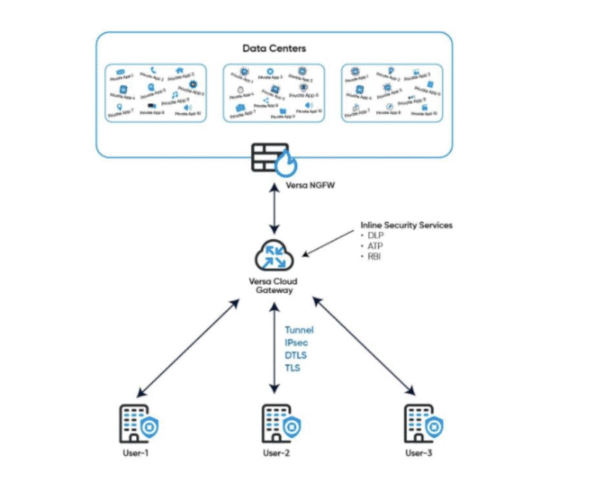
Customers can also leverage existing Versa CPEs or third-party firewalls for local connectivity. The architecture is built for global scale, high performance, and simplified operations from the start.
Key Advantages
Versa builds Zero Trust into the connectivity fabric itself, enabling secure access that operates at the speed of business.
- Inline security services
CASB, SWG, DLP, AV, IPS, ATP, Remote Browser Isolation, and UEBA operate natively within the data path. Each session is inspected in real time to detect threats before they reach applications or data. This removes gaps caused by independent point products and fragmented enforcement. - Consistent protection for internet and private access
Whether users connect with a lightweight client or through clientless workflows, security and authentication policies remain identical. This ensures uniform Zero Trust posture for contractors, BYOD, and unmanaged devices without creating alternative trust pathways. - Elastic scalability
There are no appliance-based limits or capacity ceilings that can choke performance during peak usage. Additional capacity is consumed as a cloud service, so enterprises can expand access instantly as new apps, sites, or users come online. - Optimized application performance
Routing intelligence automatically selects the lowest-latency path through the Versa Cloud Fabric. Users connect to the optimal gateway for faster response times, even when apps move across cloud or data center environments. - Single pass architecture
Unified orchestration, control, and policy enforcement drastically reduce operational overhead. Teams manage security once and have it applied everywhere, avoiding constant tuning across disjointed tools.
Strategic Advantages for the Enterprise
Zero Trust access is not only a security win. It simplifies operations, restores visibility, and improves user experience across every location and provides following:
Stronger ransomware defense
Inline threat inspection and granular access sharply reduce the blast radius of compromise. Even if credentials are stolen, attackers cannot traverse networks or reach sensitive workloads.
East-West segmentation inside the data center
ZTNA controls apply not only to users entering the network but also to traffic between workloads. Internal movement is validated and inspected to prevent infiltration from escalating silently over time.
Linear scalability without connector sprawl
No more standing up dozens of bespoke brokers across cloud and DC sites. A single scalable fabric reduces cost while delivering consistent protection across thousands of apps.
Standards-aligned Zero Trust architecture
Compliance initiatives accelerate because Versa maps directly to NIST 800-207 and similar frameworks. Using widely adopted encryption and identity standards simplifies audits and trust validation.
Future-ready design
As the business adopts new SaaS, expands globally, or modernizes infrastructure, policies and protections expand automatically with it. There’s no architecture refresh required to stay secure.
VPN architectures were never built for a world without perimeters. Versa ZTNA eliminates implicit trust and enforces Zero Trust principles consistently everywhere users connect and applications run.
Ready to move beyond legacy VPNs? Explore how Versa Zero Trust Network Access (ZTNA) compared to other ZTNA solution delivers identity-driven, secure connectivity for every user, device, and application — anywhere they connect.
Subscribe to the Versa Blog
Recent Posts
Pervasive Security and Why the AI Era Needs a New Security Model
By Dhiraj SehgalSeptember 1, 2026




Topics
Top Tags
Gartner Research Report
2026 Gartner® Magic Quadrant™ for SASE Platforms
Versa has for the fourth consecutive year been recognized in the 2026 Gartner Magic Quadrant for SASE Platforms1 and is one of only 12 vendors that met the criteria for inclusion based on the analysts’ evaluation of the VersaONE Universal SASE Platform.