Intelligent Edge: The Future of Branch and Campus in the AI Era

March 3, 2026
Introduction
Distributed intelligent computing has arrived. Processing power, data, and intelligence are no longer confined to centralized cloud or data centers. Instead, they are distributed across data centers, cloud, edge locations, campuses, branches, and even devices. While prior phases of computing, internet, mobility, and cloud fundamentally reshaped how we live and work, this next phase is poised to have an even more profound impact.
What often gets overlooked is that the network has powered every wave of transformation. Internet enabled eCommerce. Cloud enabled SaaS. Mobility enabled real-time digital engagement. Now AI is driving the democratization of intelligence and agility. The network is not just infrastructure; it is the foundation that enables innovation, scale, and secure digital experiences.
Hyperscalers are rapidly deploying AI infrastructure within massive data centers where training and inference are co-located. While this centralized AI infrastructure is essential, enterprise realities differ. Geopolitical considerations, cyber security requirements, data sovereignty, and regulatory pressures demand that AI be deployed in a distributed, secure, and cost-effective manner. For enterprises, how AI is embraced will once again be shaped by the network.
AI is forcing an Architectural Inflection Point
SaaS and cloud already increased bandwidth demand and expanded exposure to cyber threats. IoT and OT added further complexity through discovery, segmentation, and security tools. AI raises the stakes significantly. This is not another incremental upgrade. AI demands a fundamental architectural transformation.
AI is being adopted across every business function. The number of AI agents is growing rapidly compared to human users. Enterprises report daily AI usage, yet preparedness for governance and regulation remains limited. At the same time, AI-driven cyberattacks are rising sharply, increasing concerns around compliance, sovereignty, and operational risk. These pressures are forcing enterprises to rethink infrastructure architecture to align with AI deployment demands.
AI workloads, models, inference pipelines, and distributed agents are no longer centralized. Traffic patterns are becoming any-directional—east-west, north-south, and south-north. Data volumes are increasing dramatically. Distributed resources must connect dynamically and securely. What is needed is a resilient infrastructure with visibility, control, secure connectivity, and automated operations. That is where the Intelligent Edge becomes essential.
Challenges
Enterprises face structural challenges as AI reshapes infrastructure:
Topology: AI creates any-directional traffic, but networks were primarily designed for north-south flows. AI workloads reverse traditional traffic patterns, creating massive bidirectional data movement.
Visibility: Enterprises lack unified visibility across users, applications, devices, and AI-driven resources.
Control: Zero Trust implementations remain fragmented and often user-centric, not extending consistently to devices, workloads, and non-human identities.
Security: Traditional one-directional cloud security models are insufficient for distributed AI workloads and agents interacting across environments.
AI-driven transformation cannot be addressed through incremental add-ons. Unlike hyperscalers building AI-native data centers from scratch, enterprises must evolve existing environments—starting at the edge where users, devices, workloads, and AI agents intersect.
Intelligent Edge: What is it?
Enterprises require an Intelligent Edge that delivers granular access to resources, consistent performance, pervasive security, and operational simplicity. This edge may exist in a private cloud, data center, campus, branch, or remote location. It must function as a physical or virtual element and remain hardware and hypervisor agnostic.
The four fundamental elements of the Intelligent Edge are Elasticity, Resiliency, Protection, and Simplification.
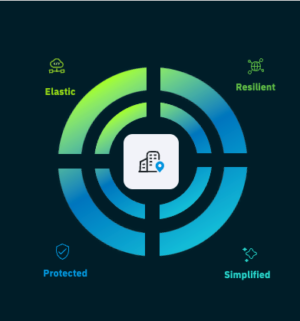
Elastic
The Intelligent Edge combines compute, network, security, and storage. It supports CPU, GPU, and DPU resources to enable AI inferencing, analytics, and security services at the edge. CPU handles control functions, GPU supports AI models and inference, and DPU accelerates networking performance.
It can natively host business applications, distributed AI models, inference services, and edge computing workloads. It collects analytics locally and supports autonomous operation during WAN disruptions, maintaining routing, security enforcement, and visibility even when disconnected from centralized control systems.
Resilient
The Intelligent Edge leverages wired and wireless LAN, internet, MPLS, 5G, and satellite connectivity to ensure uninterrupted service. It supports full-mesh, partial-mesh, hub-and-spoke, or dynamic topologies to accommodate any-directional traffic.
It prioritizes and accelerates SaaS, cloud, and AI applications while handling unpredictable traffic spikes generated by AI inference and telemetry without manual bandwidth provisioning.
Protected
The Intelligent Edge enforces granular Zero Trust controls in any direction at any edge location. It is identity-aware for both human and non-human entities. It provides defenses against malware, phishing, data leakage, shadow IT, and AI-driven threats.
It supports micro-segmentation to reduce lateral movement and enforces policy inspection across all traffic directions. It continuously validates users, devices, and applications while defending against emerging AI threats such as prompt injection and misuse.
Simplified
The Intelligent Edge is centrally managed and software-defined. It can be administered via natural language and AI agents using modal context protocol (MCP). It streams telemetry and logs for processing, correlation, and predictive analysis.
Observability extends to AI traffic flows, inference latency, model behavior, and edge compute resource consumption. Digital experience monitoring expands beyond users and applications to AI workloads.
Versa Is Delivering an Intelligent Edge Today
Versa delivers this Intelligent Edge through its platform built on the Versa Operating System (VOS) with orchestration capabilities for control and management. VOS can be deployed on purpose-built appliances, virtualized or containerized infrastructure, and private clouds. Control and management can be delivered via SaaS or sovereign environments.
Versa Intelligent Edge is built upon four pillars:
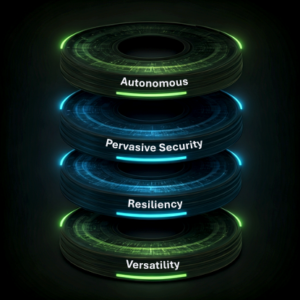
Versatility
Versa Intelligent Edge operates across physical and virtual environments with compute, network, and storage capacity. It supports CPU, GPU, and DPU configurations to meet AI, security, and infrastructure requirements. Native GPU and DPU acceleration enable AI inference, AI DLP, and AI-powered malware detection at the edge.
It can host AI models, inference services, business applications, and edge workloads. It supports sovereign deployments and multi-tenancy with strict role-based access and Zero Trust governance.
Resiliency
Versa consolidates WAN, LAN, and wireless connectivity with load balancing and failover. It supports flexible topologies and granular application prioritization across users, devices, workloads, and AI agents. It dynamically allocates bandwidth to maintain performance during traffic spikes.
Pervasive Security
Versa enforces Zero Trust across WAN, LAN, Wi-Fi, data center, and cloud edges with integrated NGFW and Security Services Edge. It supports posture-based authentication, micro-segmentation, and AI-driven threat protection. It inspects traffic in any direction and supports protection for users, devices, workloads, and agents.
Autonomous Networks with AIOps
Versa delivers operational simplicity through zero-touch provisioning and unified management. AI-powered capabilities transform how teams interact with infrastructure through contextual insights and guided actions. AI correlates events, suppresses noise, and surfaces root causes. Unified observability extends across network telemetry, AI inference activity, and edge compute utilization.
Conclusion
AI is redefining how enterprises design infrastructure. Traffic patterns are shifting. Security models must evolve. Operations must scale. The Intelligent Edge provides the resilient, secure, and AI-powered foundation required to support distributed AI workloads, users, devices, and agents across branches, campuses, and beyond.
Enterprises that embrace an Intelligent Edge architecture will be positioned to deliver secure connectivity, unified visibility, identity-based control, and automated operations at scale. To learn more about how the Intelligent Edge is shaping the future of branch and campus infrastructure in the AI era, watch our on-demand event:
Subscribe to the Versa Blog
Recent Posts

Pervasive Security and Why the AI Era Needs a New Security Model
By Dhiraj SehgalSeptember 1, 2026



Topics
Top Tags
Gartner Research Report
2026 Gartner® Magic Quadrant™ for SASE Platforms
Versa has for the fourth consecutive year been recognized in the 2026 Gartner Magic Quadrant for SASE Platforms1 and is one of only 12 vendors that met the criteria for inclusion based on the analysts’ evaluation of the VersaONE Universal SASE Platform.