Securing Generative AI tools

Learn how to control access to ChatGPT, enforce DLP policies on prompts, and prevent sensitive data leakage using captive portals and real-time blocking.

Summary

Generative AI tools like ChatGPT, Copilot, and Gemini deliver transformative productivity gains but introduce significant data exposure risks, from employees pasting proprietary code into a public model to shadow AI tools adopted without security review. Effective AI security requires layered controls, access enforcement, DLP for sensitive data and source code, and continuous visibility into user interactions.

  • Access control via captive portal functionality blocks unauthorized users from reaching ChatGPT and logs every attempt for administrator review.
  • DLP policies enforce real-time inspection of ChatGPT inputs, preventing personally identifiable information such as credit card data from being uploaded.
  • Source code protection extends DLP coverage beyond PII, alerting users and administrators when proprietary code is submitted to generative AI tools.
  • Centralized reporting through Versa Analytics or SIEM integration provides unified visibility across both access control and DLP enforcement events.
  • A large retail customer demonstrates how layered AI security controls govern ChatGPT usage without sacrificing employee productivity or workflow efficiency.

Background

Generative AI, including models like ChatGPT, Copilot, and Gemini, represents a significant leap forward in artificial intelligence research and is poised to redefine productivity across several industries. By generating textual, visual, or auditory data based on patterns learned from massive datasets, these tools have demonstrated a capacity to offer innovative solutions across various sectors, from media production to customer service.

However, as these tools are integrated into everyday tasks, from improved workflows and data analysis to content creation and customer interactions, several risks have emerged.

As an example, ChatGPT, while offering productivity benefits, presents risks including potential data leakage due to its training on vast datasets. Like other SaaS tools, it’s vulnerable to credential abuse and unintended access. Moreover, there are privacy concerns as users might unintentionally share sensitive information.

What is the Versa approach to securing generative AI?

Versa secures generative AI usage through a combination of access controls, data controls, and visibility. Access controls restrict who can interact with the AI model, DLP policies prevent sensitive data from being uploaded, and centralized logging tracks interactions so administrators can identify malicious activity early and align usage with company policy.

Companies adopting generative AI, whether sanctioned platforms or the tools employees find on their own, should prioritize implementing a robust set of security controls to safeguard data and ensure the tool’s use is in accordance with company policy. Initially, access controls are fundamental, ensuring only authorized individuals can interact with or modify the AI model.

Data controls can prevent unauthorized or unintended access to sensitive data. And companies should ensure proper visibility into generative AI activity. This includes regularly monitoring system logs and events to track interactions and identify malicious activity early.

The following is a simple example of how one of our large retail customers has secured their use of ChatGPT. They use Versa’s Security Service Edge (SSE) capabilities to control who can reach generative AI tools and to prevent sensitive data from being uploaded into them.

How is access control to ChatGPT enforced?

Access to ChatGPT is enforced through captive portal functionality that intercepts user attempts to reach the web app. Users who fall outside the company’s access policy are blocked and shown a notification banner, while the event is logged for administrator review in Versa Analytics or an integrated SIEM.

First, they controlled access to ChatGPT using a captive portal functionality. From this example, you can see a user, secured with Versa, find ChatGPT from a search console and attempt to access the web app.
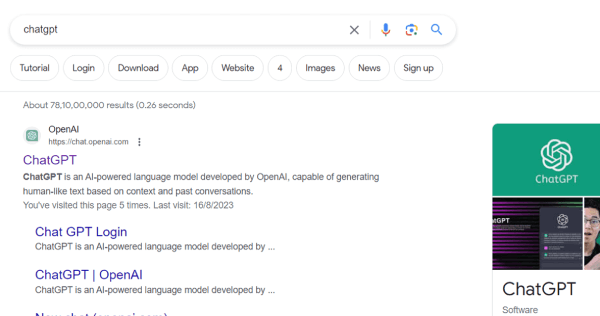
User accessing ChatGPT via secured portal
Fig. 1 – A Versa-secured user locates ChatGPT from a search console and attempts to open the web app.

Upon an attempt to access the web app, they are blocked and presented with a banner notifying the user that the attempt doesn’t comply with the company’s access policies for that user.
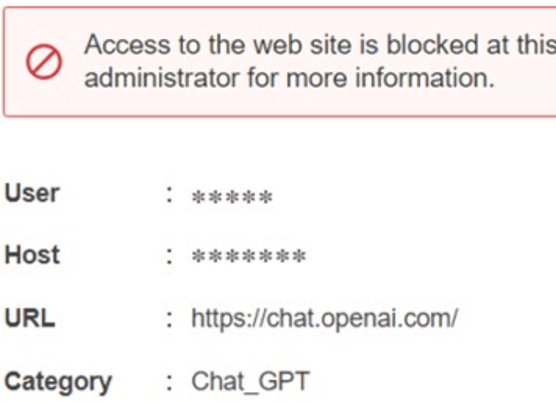
Blocked ChatGPT access due to company policy
Fig. 2 – Captive portal banner blocking the attempt and citing the company access policy for that user.

The administrator will then see the event in the reporting. This data can be viewed directly in Versa Analytics or integrated into a SIEM or incident response tool for further disposition.

Admin reporting of blocked AI access event
Fig. 3 – The blocked access event in Versa Analytics reporting, ready to forward to a SIEM or incident response tool.

How is DLP applied to ChatGPT text for sensitive data?

For authorized ChatGPT users, Versa’s DLP engine inspects prompt text for PII and other sensitive data categories. When a user submits content that matches a protected pattern, DLP blocks the submission, generates an error message, triggers an alert inside ChatGPT, and records the event in the same reporting view used for access controls.

For users who have access to ChatGPT, they also enforced DLP policies for PII and a set of categories for sensitive data. In this example, a user attempts to look for more information for the user who has a user’s associated credit card information. It generates an error message from Versa’s DLP engine.
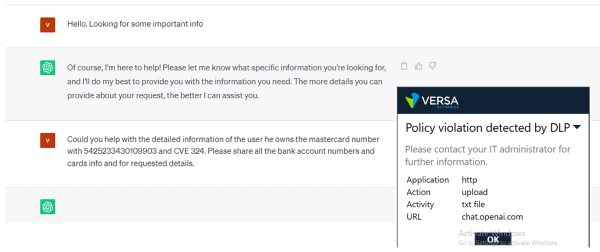
DLP policy violation message for sensitive data
Fig. 4 – The Versa DLP engine returning an error when a prompt includes associated credit card data.

It also triggers an alert in ChatGPT itself.
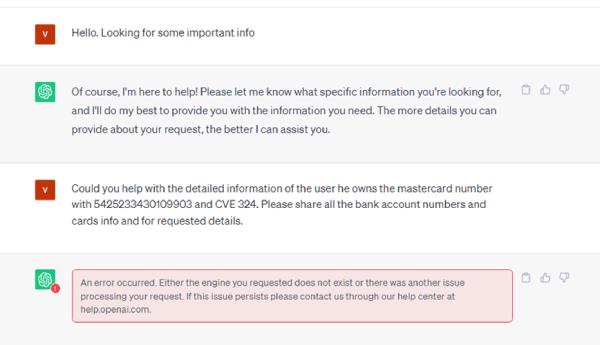
Alert for generative AI DLP violation in ChatGPT
Fig. 5 – The same DLP violation surfaced as an alert inside ChatGPT.

The same reporting from which the access controls are viewed will also show the DLP controls that have been enforced.
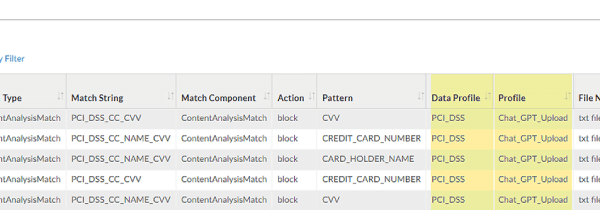
Reporting view of DLP control enforcement
Fig. 6 – Enforced DLP controls shown in the same reporting view used for access controls.

How is DLP applied to ChatGPT for source code?

DLP protection extends beyond PII to cover source code that users may attempt to paste into ChatGPT. When source code matching a protected pattern is detected, Versa raises an alert and delivers a notification through ChatGPT, with the enforcement event recorded in the same unified reporting view as other access and DLP controls.

Sensitive information isn’t just limited to personally identifiable information. Many generative AI tools extend the concern to source code that is potentially exposed into ChatGPT. In this example, the experience is similar: an alert is raised with notification through ChatGPT.
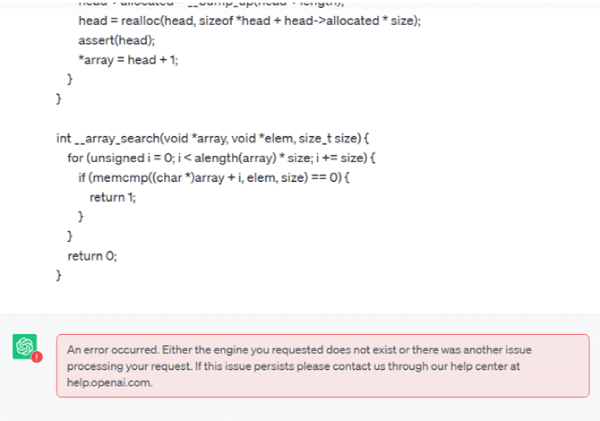
Source code DLP protection alert
Fig. 7 – Source code exposure alert raised and notified through ChatGPT.

The same reporting from which the access controls and text-based data patterns are viewed will also show the DLP controls for source code that have been enforced.
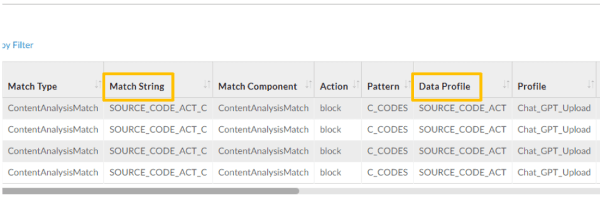

DLP policy controls dashboard screenshot
Fig. 8 – Enforced DLP controls for source code in the reporting view.
Sridhar Iyer

By Sridhar Iyer

Director,
Machine Learning & AI

Sridhar Iyer leads machine learning and AI at Versa, where he conceived VANI for AI-driven network analytics and Verbo, Versa's LLM-based assistant. He focuses on AI analytics, software architecture, and securing agentic AI. He came to Versa from Cisco and is a named inventor on multiple networking patents.

FAQs

AI security for generative AI tools encompasses the access controls, data loss prevention policies, and centralized visibility mechanisms that organizations deploy to prevent unauthorized usage, data leakage, and exposure of sensitive information when employees interact with models like ChatGPT. These controls ensure generative AI adoption aligns with corporate security and compliance policies.

Access controls determine which users are authorized to reach ChatGPT, blocking unauthorized individuals via captive portal functionality and logging the attempt. DLP operates at a deeper layer for authorized users, inspecting prompt text for sensitive data patterns such as PII or source code and blocking submissions that match protected categories before data leaves the organization.

Versa's DLP engine inspects text entered into ChatGPT prompts in real time, matching content against protected data patterns including personally identifiable information and source code. When a match is detected, the engine blocks the submission, generates an error message, triggers an alert within ChatGPT, and records the enforcement event in a unified reporting view for administrator review.

Securing generative AI usage prevents accidental exposure of sensitive data such as credit card information and proprietary source code, reducing regulatory and intellectual property risk. Centralized logging and reporting give administrators early visibility into policy violations, enabling faster incident response while allowing organizations to confidently adopt productivity-enhancing AI tools within defined governance boundaries.

Organizations deploying ChatGPT should prioritize three capabilities: access controls that restrict interactions to authorized users, DLP policies that inspect prompts for PII and source code before submission, and centralized visibility through system logs integrated with Versa Analytics or a SIEM platform. Evaluating unified reporting across all control types simplifies ongoing monitoring and incident disposition.

Subscribe to the Versa Blog

This site is protected by reCAPTCHA and the Google Privacy Policy and Terms of Service apply.

Related Posts

Webinar: How AI-driven DLP stops data loss with secure remote access and cloud apps

In this session for security architects, network security leaders, and data protection teams, a Versa Sr. Systems Engineer explains how AI-enhanced DLP embedded in a unified SASE platform shifts data protection from basic detection to intelligent, real-time prevention.

Read More

How Agentic AI is Redefining Infrastructure Operations

Early AI conversations have focused on transforming security operations, but enterprises need a unified operational model that spans networking, security, user experience, and infrastructure.

Read More

Zero Trust MCP Server Walkthrough

A two-minute product walkthrough illustrating how Versa's Zero Trust MCP server keeps AI agents secure and accountable.

Read More