Reigning in and managing AI applications across the enterprise is a daunting task for the NetOps team. In most enterprises there is at least one sanctioned GenAI copilot embedded in the productivity suite, unsanctioned riskier GenAI apps being evaluated, a coding assistant in every developer’s IDE, a handful of consumer chatbots employees reach for on their own, AI features added into existing SaaS apps, and a growing number of agents calling model APIs with no human in the loop. All of this activity shares the same WAN links, the same internet breakout and the same campus uplinks as voice, video, ERP and everything else the business depends on.
The network pressure from this rapid increase in flows is already visible. Across the industry, IT and networking leaders are reporting rapid year over year growth tied to AI. The question for network teams is no longer whether to make room for GenAI. It is how to allocate it fairly without letting any one class of traffic, GenAI included, crowd out the rest.
What’s the priority?
Much of the current conversation lands in one of two places: steer AI traffic onto the best available path, and secure sanctioned AI usage with DLP and access controls. Both focuses matter, but neither answers the problem question that shows up on a congested branch circuit at 10 a.m. on a Monday. When this event occurs, there are two failure modes, and they pull in opposite directions:
- Starve GenAI: This can result in responses occurring in longer-lived sessions, queueing delays and losses on saturated links, which the user will see as stalled or choppy output, and reduced productivity on the workforce relying on these tools to improve the rate and efficacy of output.
- Starve everything else: This can impact much more important operations for the company’s workflows, such as file and image activity across applications, transactional workflows for sales, resource, or other applications, and real-time productivity or collaboration tools the company relies on to execute business.
Treating AI generically as a single QoS class doesn’t adequately address either problem. Research on popular chatbots shows why. For example, a 2025 research study of ChatGPT, Copilot and Gemini mobile apps found distinct traffic footprints for each, including different transport choices (Gemini over QUIC, ChatGPT over TLS 1.3), different upstream and downstream profiles, and heavier upstream activity than conventional messaging apps. That study covered mobile apps rather than enterprise desktops, but the lesson carries across: AI applications do not all share one traffic profile, so they should not share one policy.
Step 1: Identify AI traffic patterns
Differentiated QoS starts with accurate AI classification. Versa application intelligence, built on an inline deep packet inspection engine that can recognize over 3,600+ different applications, identifies many SaaS applications from the first packet sent. That means Versa policy, including QoS, applies from the start of the flow rather than after the session is already established. The same discovery capability also includes AI applications and AI-based URL endpoints, which Versa recognizes and can monitor across branches, remote users and cloud environments.
In addition, rather than lumping AI applications into a generic “AI” category, Versa can classify each AI application, mark it sanctioned or unsanctioned, and set granular rules for its use across the organization. That classification is the raw material for everything that follows because the QoS policy you want for an approved enterprise copilot is not the same policy you want for an unvetted consumer AI tool.
Step 2: Establish differentiated QoS for AI applications
Because AI applications are different, the policy needs to shape traffic for each application where they are not starved of bandwidth, but also are not starving other applications and workloads on the same network. Delivering an effective floor and ceiling of network bandwidth, especially during a congested networking window, is the difference between applications performing and completing their operations, and failures resulting in call center tickets to the network operations team. Together they deliver fairness that a simple priority queue cannot, because strict priority alone can let a high class monopolize a link.
Versa’s QoS framework maps naturally onto this model:
- Classification by application, URL category, user and group. Application-aware QoS policies match on Layer 7 application identity and URL category in addition to Layer 3 and 4. Specific AI application traffic can be placed in its own forwarding class instead of riding with generic web traffic. Versa Secure SD-WAN QoS and traffic engineering policy can also be keyed to user and group identity, such as applying QoS for AI traffic used by engineering, sales, and finance applications ahead of others.
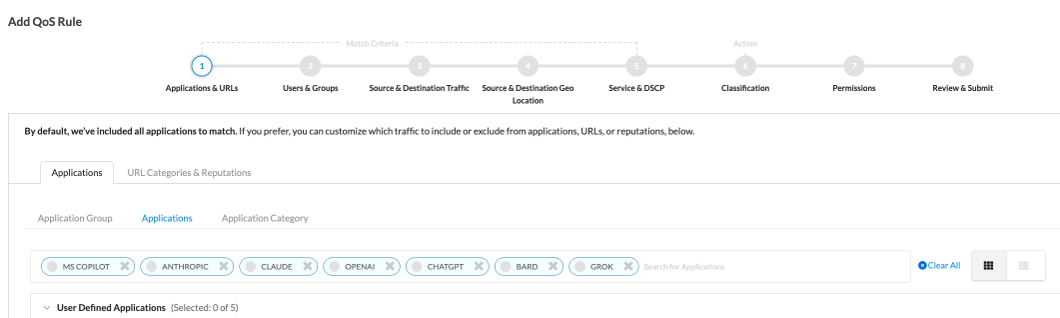
- Floors through hierarchical scheduling. Versa shapes traffic at three levels: port, pipe, and traffic class. Each class gets a scheduler defined as a percentage of the port shaper rate or an exact rate, which is how a class receives a guaranteed share while a port-level shaper keeps higher-priority classes from starving the rest.
- Ceilings through policing and shaping. Versa policing enforces a peak rate with a configurable burst size, with application QoS policing running bidirectionally. The burst allowance matters for AI applications, where prompts and streamed responses are bursty, and a ceiling that clips short bursts will hurt the experience without saving meaningful bandwidth. This can also serve as a guardrail for agentic workflows where a single user request generates many AI exchanges, since per-service or per-group ceilings can trigger alerts and help identify runaway loops before they saturate a site’s bandwidth.
- Per-tenant limits. On multitenant deployments, per-tenant shapers set how much WAN bandwidth each tenant may use, which matters to MSPs and to enterprises that segment business units. By deploying per-tenant shapers, you can eliminate noisy neighbors impacting your organization’s network experience.
- Adaptive shaping. A receiving site can signal its input rate back over the SD-WAN control plane so that sending sites throttle only toward the congested destination. This allows QoS to not only be managed based on source side available bandwidth, but also on target side bandwidth availability.
Step 3: Deliver QoS with path intelligence
While QoS decides who gets what share of the bandwidth, path selection decides which link the application flow uses. Versa Secure SD-WAN continuously measures link and application performance such as bandwidth, latency, jitter, loss, and MOS across MPLS, broadband, 5G/LTE and satellite links, and uses that data for application-based link selection and re-routing, with techniques such as forward error correction, TCP optimization, and packet duplication available for sensitive or important flows.
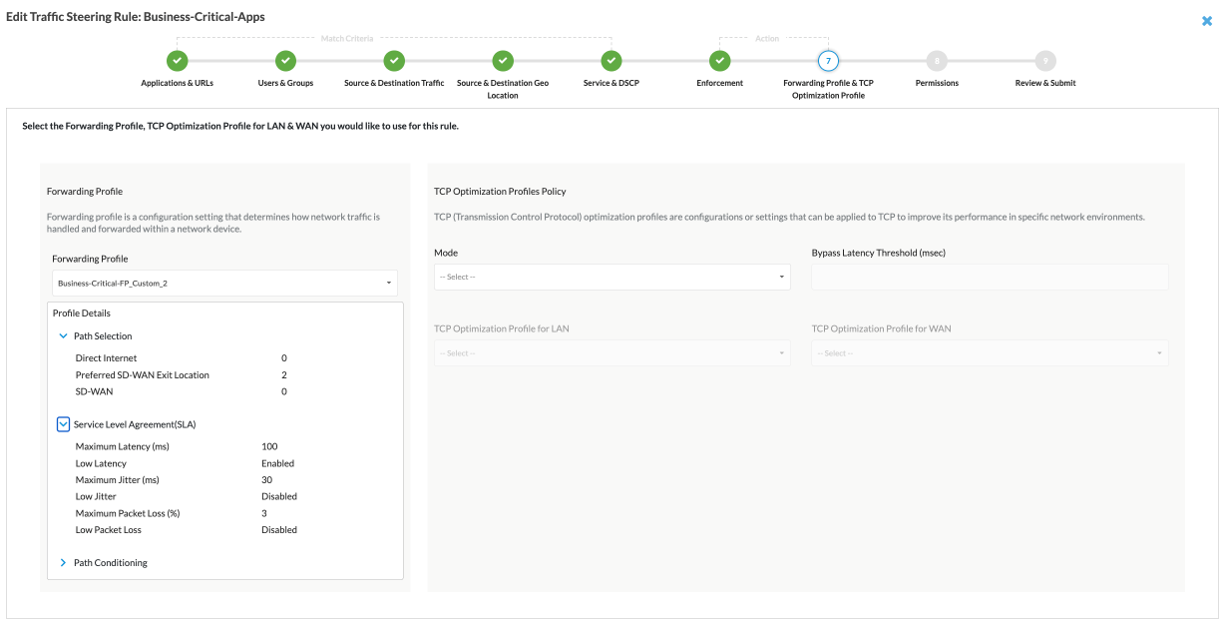
For AI applications, the combination of QoS and path intelligence means a sanctioned coding assistant for engineering development can be steered to the best-performing path while its floor protects it on whichever path it lands, and lower-priority GenAI copilot traffic for general work queries can take alternate paths with ceilings to ensure that it does not starve other traffic that needs to be processed for other business workloads.
Step 4: Add in governance in the same policy
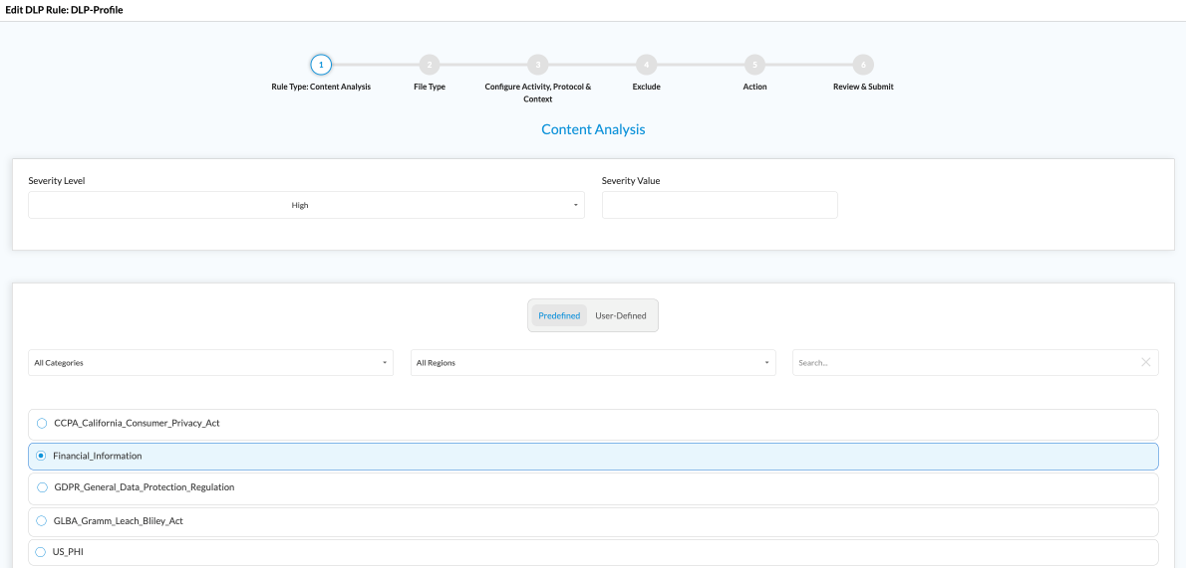
Versa’s GenAI firewall delivers AI governance in the same unified SASE platform, using the same policy engine shared with SD-WAN and SSE. This design improves usability for QoS because governance decisions are often the inputs for performance decisions. For example, sanctioning AI applications means worrying less about unsanctioned AI applications capturing bandwidth and creating an unknown choke point in the network, as classifying them can ensure availability for departments that need them, while restricting them from those that do not need to access them.
In addition, security policies such as DLP and CASB can be implemented to ensure that activity is monitored for sensitive data being sent and received from the AI application, and that no prompt injection attacks can hijack sessions or compromise data during an AI interaction.
Finally, visibility across all applications in the stack and their impacts on the network, can be viewed in a single pane of glass, with workflows being able to be tracked across the network stack.
Where does an organization start?
Every journey should start with AI discovery. Understand what is in the environment, what the organization wants to allow, and how the usage is shaped by application, users, groups, and sites. This can help objectively identify what requirements are needed to ensure equitable delivery of bandwidth to all business priorities. Evaluate and recognize the asymmetric bandwidth utilization of AI applications to help right size the environment relative to the expected consumption of network resources for operations and prioritize these to reduce the potential number of constraints QoS policies need to enact on an environment when bandwidth is constrained during peak periods.
Of course, AI applications will continue evolving, and new patterns and traffic shapes will evolve as tools and capabilities improve for each application workflow. What should not change is the disciplined methodology when identifying changes, evaluating impacts, and treating AI application updates and their bandwidth requirements as these applications evolve. Ensuring business priorities align with the data’s treatment will ensure fairness and availability across your network, and that no single source takes more than its fair share.
Versa brings differentiated QoS, path intelligence, and enterprise-grade AI governance together under a single unified policy, management, and visibility framework so that performance and control are managed efficiently and effectively by the network team. Want to see it in action? Learn more about Versa Secure SD-WAN solutions for your enterprise, request a demo, or contact us to see how you can unlock the most value from your enterprise network.