Service providers already connect their customers’ branches, remote workers, and clouds. That connection is a natural place to add managed networking and security services, which earn higher margins than connectivity alone and give customers more reasons to stay.
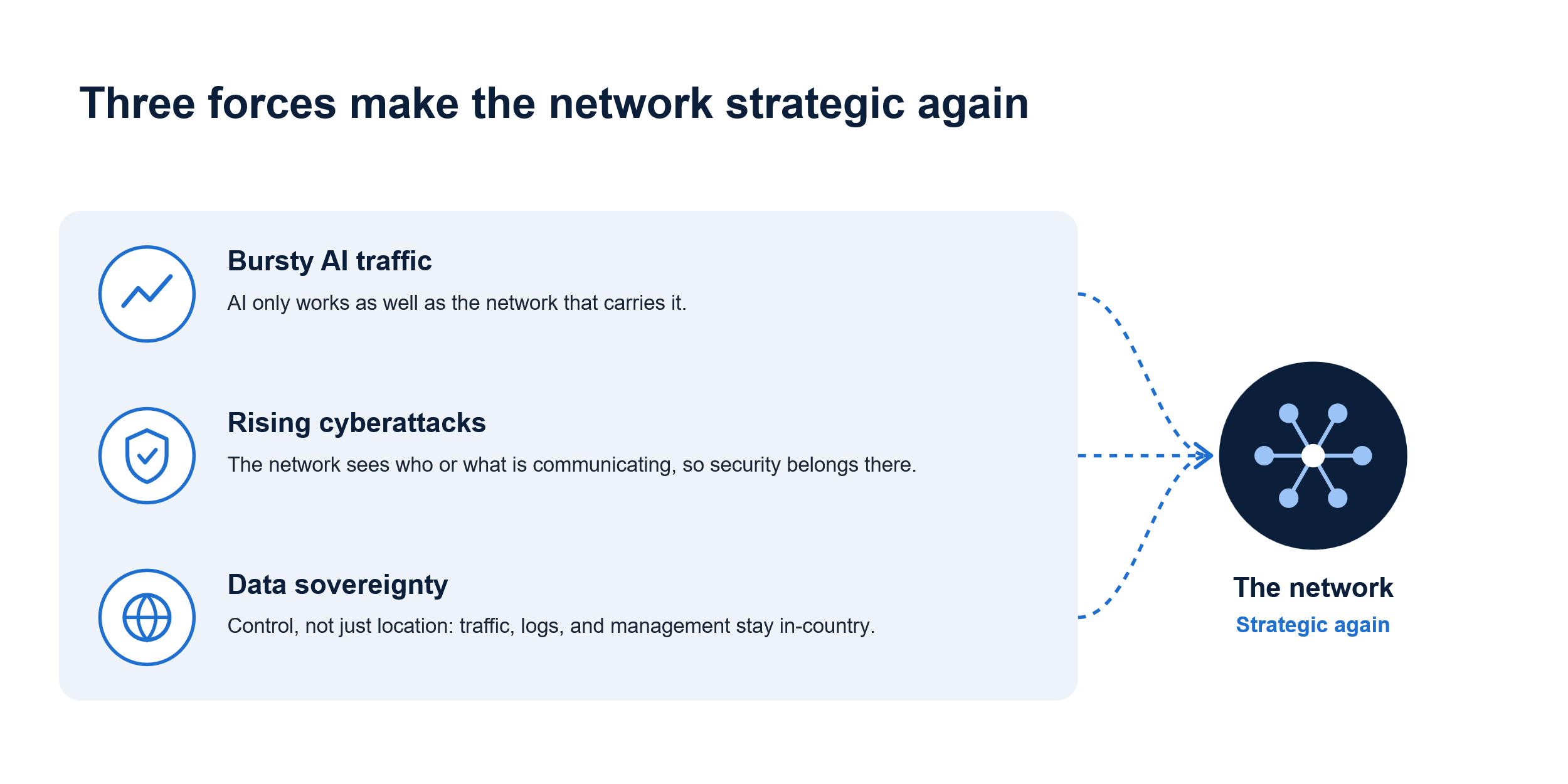
Customers are already asking for these services, for three main reasons: AI, security, and data sovereignty.
AI traffic is bursty and hard to predict, and AI applications slow down when the network can’t keep up. Security is moving into the network, because the network already sees who and what is communicating. Data sovereignty rules often favor local providers, and they cover more than where data is stored. For example, a US federal agency needs its traffic, logs, and network management to stay in the United States, under US jurisdiction. Banks in Germany and India have similar local requirements. On top of this, many small and mid-sized businesses don’t have the in-house expertise to run networking and security, so they want a provider to do it for them.
What matters most is how quickly you can launch a service and get customers on it. A hardware-led rollout typically takes 12 to 18 months. Swisscom now launches new services in weeks.
How a universal edge works
Picture one of your business customers: a company with 50 branch offices, each connected to the internet through your service. Today, if that customer asks you to manage their firewall, you typically ship and install an appliance at every branch, then repeat the process for each new service they buy. A universal edge changes where those services run. Your edge is the part of your network closest to your customer: the router at each branch and the PoPs where branch traffic enters your network. Once Versa software runs at these points, they can deliver routing, firewall, secure internet access, and other services from the same platform. That’s why we call it a universal edge: the same platform runs at every edge point and can run any service you offer. When your customer asks for a managed firewall, you turn it on centrally, and all 50 branches are covered without a site visit. Each additional service is a configuration change (Figure 2).
The edge also recognizes AI traffic. When an application sends a large batch of training data, the edge identifies it and routes it accordingly. Every service is managed from one console, one policy engine, and one data lake, so you don’t build a separate stack for each new service.
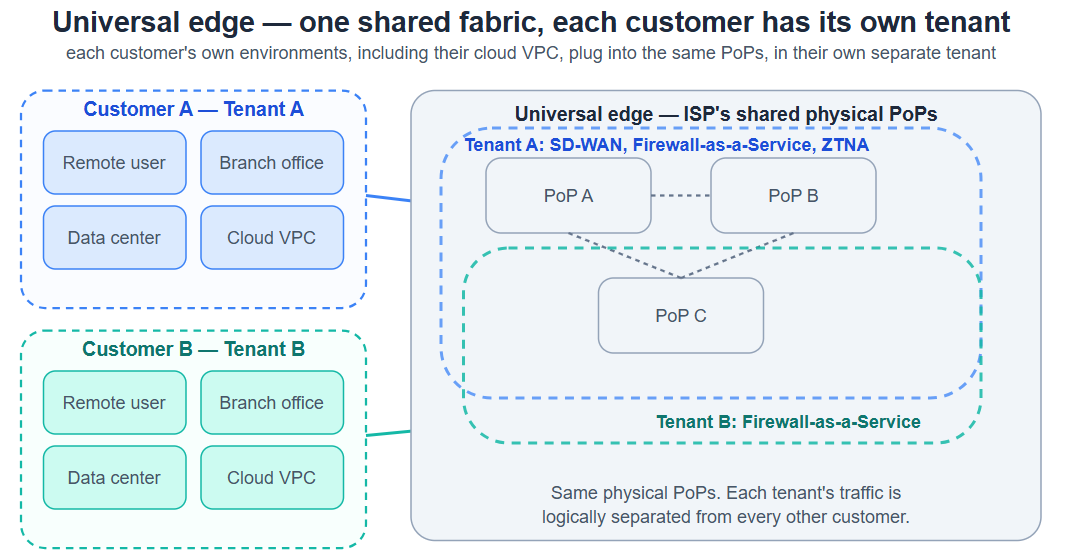
Figure 2: Versa Universal Edge: one shared fabric. Each customer, such as a bank or a retailer, connects to the same PoPs while remaining in its own separate, secure tenant.
Remote workers, clouds, and new locations
Your customer’s business also extends beyond its branches. Employees work from home, applications run in several clouds, and AI models may train in one region and serve users in another. A universal edge covers these too. Remote employees connect to the nearest gateway, so their traffic goes through the same edge as branch traffic. The same policies apply whether that traffic goes to a cloud application, a data center, or the internet. When your customer expands, for example by adding a service close to shoppers in Tokyo, you add an edge point there without changing anything already running.
The same edge handles sovereignty. Take the US federal agency mentioned earlier. It needs the systems that set policy, store logs, and manage the network to stay in the country along with its data. With Versa, you keep the data, policy decisions, logs, and administrative access in-country, under local law. Swisscom’s beem service runs this way in production today.
All of this runs on shared infrastructure, and each customer stays separate. Your 50-branch customer, a hospital, and a law firm can use the same PoPs, and each one sees only its own traffic, policies, and reports. That means you can sell each customer a different mix of services, such as SD-WAN to one, managed firewall to another, and full SASE to a third, all from one platform. If a customer wants more control, you can let it manage some settings, such as its own policies or reports, while you keep oversight.
How long it takes to launch a service
The traditional way to launch a new service runs through hardware: order equipment, ship it, install and configure it at every PoP, then test and launch. That typically takes 12 to 18 months (Figure 3). With a universal edge, the Versa gateways at the PoPs stay the same. You add the new service in software, set the policy centrally, and it’s live for every customer who buys it. That takes weeks.
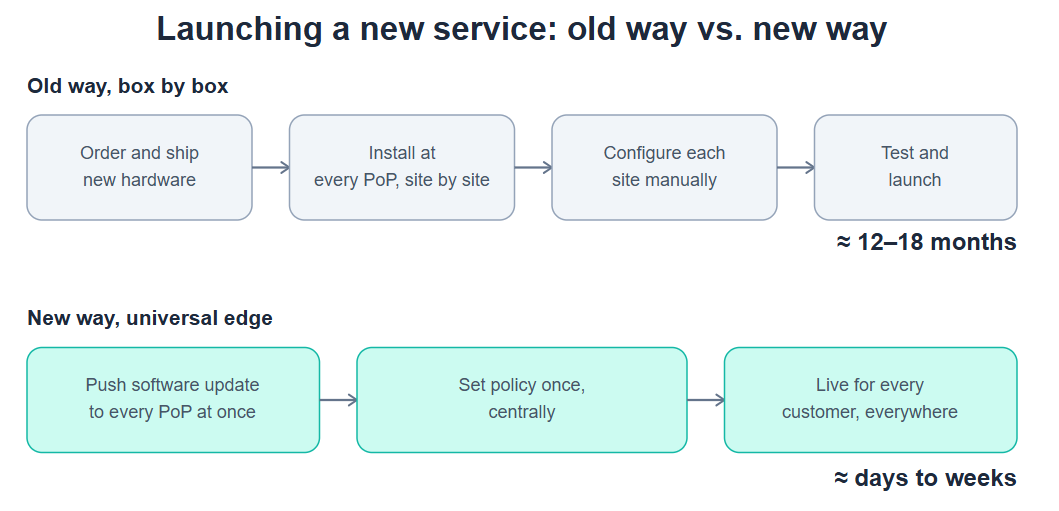
Figure 3: Launching a new service: the traditional hardware rollout takes 12 to 18 months. On Versa Universal Edge, the same service reaches customers in weeks.
What it costs
Customer demand changes quickly, and with a software-based edge you can keep up without replacing hardware each time. Every service runs on the same platform, so you reuse what you’ve already built for each new service. That lowers both capital and operating costs.
Every customer already on your universal edge can buy another service from you. For example, you can offer a managed firewall or secure remote access as a configuration change, and they can start using it right away. Each one adds revenue without adding another vendor’s system for you to run.
Ways to get started
You don’t have to do this all at once. You can start in one of three ways: run Versa software on your own network, use Versa’s shared infrastructure, or have Versa build and run dedicated infrastructure for you. You can switch between these as your business grows. For example, a regional provider might launch its first services on Versa’s shared infrastructure, then move them to its own network once demand justifies the investment. You can sell every service under your own brand or co-brand it as “powered by Versa.” Either way, you keep the customer relationship. Swisscom, Arrow, and T-Mobile are already doing this with Versa.

Anil Gupta covers Versa's firewall and network security portfolio, focusing on how the Next-Generation Firewall delivered through Universal SASE protects enterprise, cloud, and operational technology environments. He writes on securing industrial systems, segmenting flat OT networks, and aligning firewall architecture with frameworks like Gartner's hybrid mesh firewall model.