Every three to five years, your enterprise firewall vendor forces your hand. Hardware reaches end of life, licensing costs climb, and a renewal notice lands on your desk. For most security directors, this refresh cycle feels like a procurement event to get through, not a decision that deserves real strategic weight. That instinct is worth challenging: the refresh window is the one moment in the contract cycle when switching costs are lowest, because downtime is already planned and budget is already in motion. Treated as a default renewal, it’s a missed opportunity. Treated as a structured evaluation, it’s the best chance you’ll get to reset the relationship between security effectiveness, performance, and cost, on your terms rather than your vendor’s.
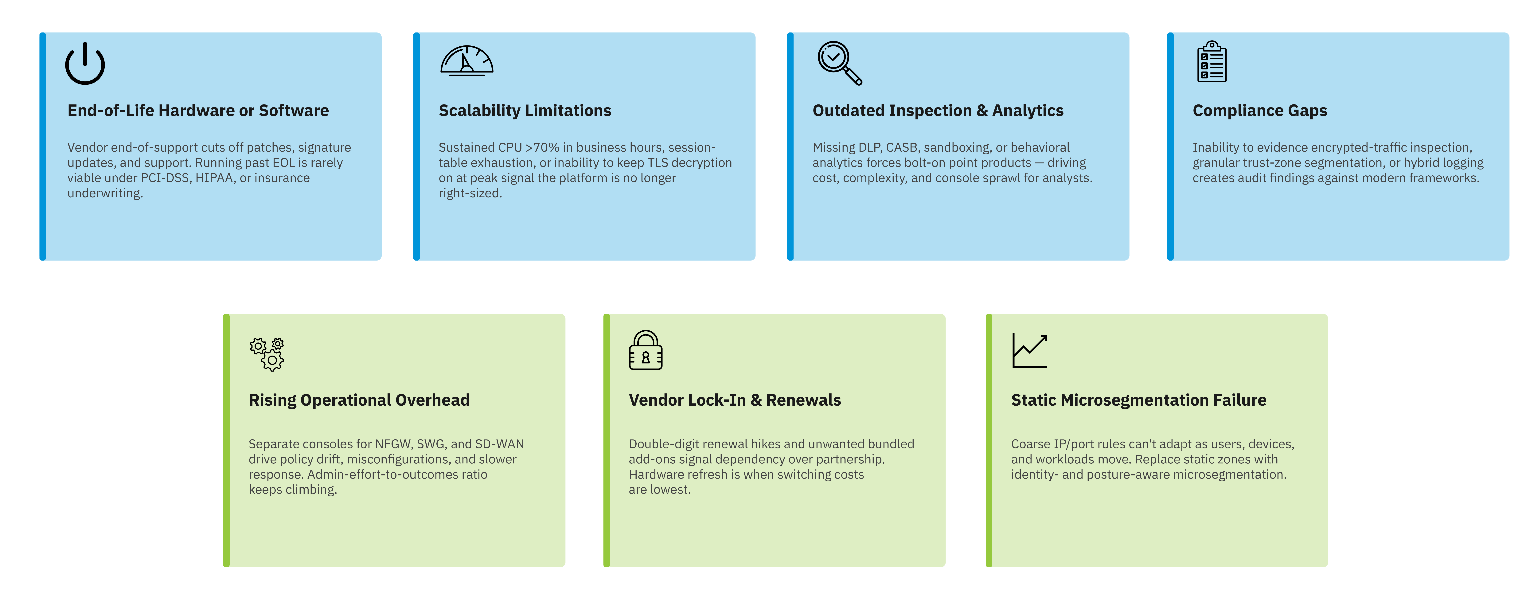
Figure: Indicators it is time to replace your firewall
Why replacement at refresh matters
The pressure to act isn’t hypothetical. Several forces are converging at once, and legacy platforms are increasingly unable to absorb them.
End-of-life exposure. Vendor end-of-support timelines are accelerating. Fortinet’s own 2025 earnings call disclosed that over 25% of its active appliances will reach end-of-support by 2026, with another 15% in 2027. That’s the vendor’s schedule, not yours.
Performance ceilings. Legacy hardware often can’t sustain today’s traffic volumes with TLS decryption, deep packet inspection, and IPS all running together, which is exactly why so many teams quietly disable some decryption to preserve latency, leaving a large part of encrypted traffic uninspected.
Widening security gaps. Independent CyberRatings.org (NSS Labs) Q4 2025 testing found effective protection rates ranging from 46.37% to over 99% across leading vendors, with throughput differences exceeding 10x once full inspection is enabled.
Compliance strain. GDPR, PCI-DSS, HIPAA, and emerging AI-governance rules increasingly assume controls—including encrypted traffic inspection, granular segmentation, and comprehensive logging—that older, coarse IP/port-based platforms simply can’t evidence.
A forced budget event either way. Renewal pricing on legacy platforms routinely bundles threat intelligence, sandboxing, DLP, and cloud connectors, sometimes doubling costs. Since the spend is happening regardless, the only question is whether it buys more security and throughput per dollar.
Why this is a strategic opportunity, not just a refresh
The environment your firewall now has to protect looks nothing like the perimeter-defense world most installed platforms were built for.
Hybrid workforces need identity-aware, application-aware policy that follows the user, not static rules tied to a branch-office IP range. Zero Trust has to become part of the security architecture, not an add-on to it.
IoT and OT proliferation keeps expanding the attack surface with devices legacy firewalls can’t fingerprint, classify, or protect until one is already compromised.
Multi-cloud environments often end up secured by one on-prem vendor and a different cloud bolt-on, creating policy drift and coverage gaps at the seams.
Increasingly sophisticated threats—ransomware, encrypted C2, and AI-driven attacks—demand line-rate TLS decryption and behavioral analytics that signature-only detection on aging hardware can’t deliver.
Put together, these shifts mean the question at refresh isn’t “what’s the closest like-for-like replacement?” It’s “what does our security architecture need to become for the next three to five years?” That reframing is where the strategic value sits, but only if the transition is planned, not rushed.
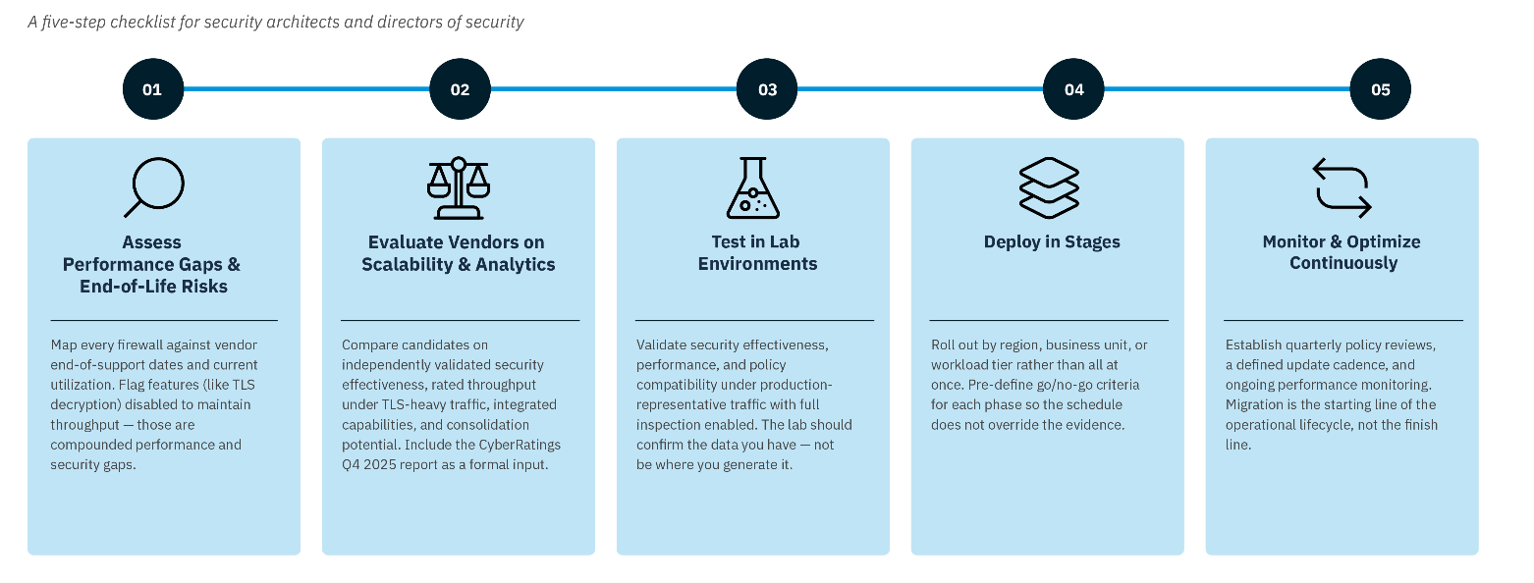
Turning the opportunity into a plan: a roadmap for the refresh
A well-executed firewall replacement is a structured program, not a weekend cutover. Versa’s eBook, The Definitive Guide to Replacing Your Enterprise Firewall During the Hardware Refresh Cycle, lays out the roadmap security teams need to execute the transition without disrupting production traffic or downstream security operations. At a high level, it walks through six steps:
1. Start planning 12–18 months out. Begin well before end-of-life to allow time for budget approval, vendor evaluation, and a real proof of concept, without the time pressure that forces a like-for-like decision.
2. Define objectives before you evaluate. Translate goals like Zero Trust, SASE adoption, IoT/OT visibility, and point-product consolidation into measurable criteria, so the evaluation compares outcomes, not just feature checklists.
3. Test and validate against real traffic. Run a lab proof of concept mirroring your production traffic mix, with TLS decryption and full inspection enabled, anchored against independent data such as CyberRatings.
4. Choose the right deployment model. Weigh on-premises NGFW, cloud-native firewall, Firewall-as-a-Service, and hybrid models against your traffic patterns and target operating model. Most enterprises land on a consistent-policy mix of several.
5. Deploy in stages. Run the new platform in parallel first, cut over non-critical systems before critical ones, and validate throughput, latency, and policy accuracy under full, production-realistic load.
6. Capture the ROI. Track the payoff across reduced refresh cycles, consolidated licensing, and fewer security incidents. Returns compound over the full three- to five-year ownership window.
The refresh window and why it matters for what comes next
Each of these steps, along with detailed checklists, is covered in the eBook linked above. As compliance requirements tighten and AI-driven threats accelerate, the cost of treating a refresh as a like-for-like swap only grows—organizations that use this window to move toward Zero Trust and SASE-aligned architecture are setting the security bar for the next cycle, not just meeting last cycle’s.
The refresh notice on your desk isn’t just a bill to pay. It’s the one predictable moment when you can re-evaluate, re-negotiate, and re-architect, with the least disruption you’ll ever have to accept the change. Here’s how Versa helps: talk to our team about mapping your refresh timeline to a Zero Trust, SASE-ready architecture before your next renewal notice arrives.

Anil Gupta covers Versa's firewall and network security portfolio, focusing on how the Next-Generation Firewall delivered through Universal SASE protects enterprise, cloud, and operational technology environments. He writes on securing industrial systems, segmenting flat OT networks, and aligning firewall architecture with frameworks like Gartner's hybrid mesh firewall model.