Enterprises have bought into the benefits of SASE. According to a recent press release by Dell’Oro Group the SASE market will grow to $97 billion in five years. When implemented right, with the right vendor, it makes the network more efficient and more secure while reducing total cost of ownership. A win, win, win! But why is single-vendor unified SASE significantly more beneficial than just SDWAN + SSE from different vendors?
The many advantages stem from the fact that it requires twice the effort to use two separate products, along with the need for customization where integration points are not standards-based. Training, provisioning, integration, management, troubleshooting, network tuning, and security operations correlation, detection and response efforts are all compounded in their effort. Here below is a list of the top 10 considerations.
How does single-vendor SASE reduce implementation and operational costs?
Teams don’t need to learn two platforms, avoid manual IPsec tunnel provisioning for branches and data centers, and remove the overhead of running multiple consoles, support relationships, and patching cycles for separate vendor systems.
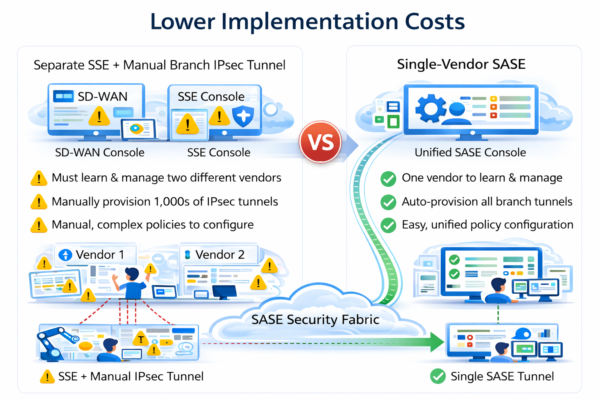
1. Lower implementation costs
Using single-vendor SASE lowers implementation costs.
- IT teams do not have to learn products from two different vendors
- They do not need to provision thousands of IPsec tunnels manually for each branch and data center in order to access SSE gateways
- Also, by using unified policies they do not need to create custom policies to integrate separate network and security systems
2. Lower operational costs
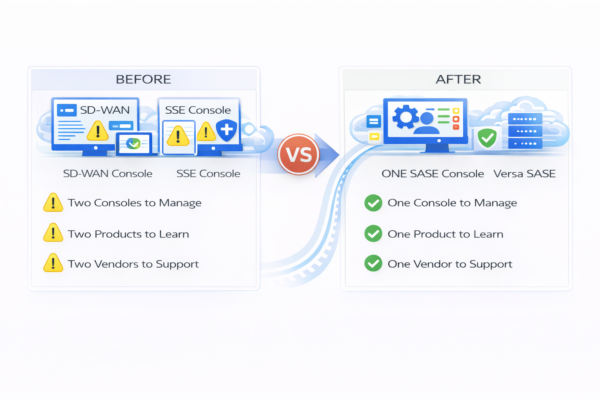
Using single-vendor SASE lowers operational costs, saving time and money.
- IT teams do not have to use multiple consoles to monitor network and security activities
- They do not have to contact support at different vendors
- They do not need to implement software patches for vulnerabilities from different vendors
How does single-vendor SASE improve security operations?
Single-vendor SASE also enables single-vendor agentic AI and a unified LLM to deliver automated, actionable alerts with clear response guidance for faster, more accurate investigations.
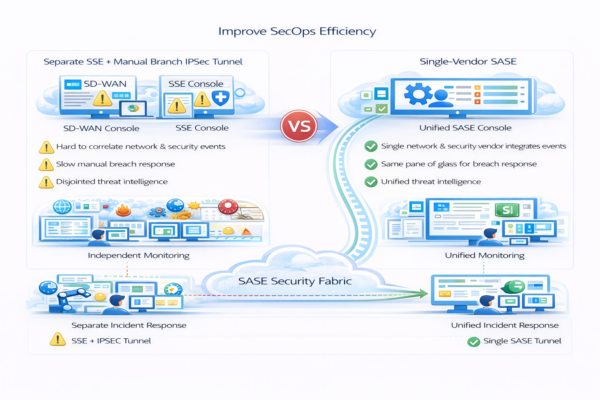
3. Improve SecOps efficiency
Using single-vendor SASE improves security operations efficiency.
- With separate vendor products SecOps teams are challenged to correlate network and security events
- Breach response is delayed with multiple systems and consoles
- Threat intelligence from multiple vendors is inconsistent and disjointed
4. Security event correlation
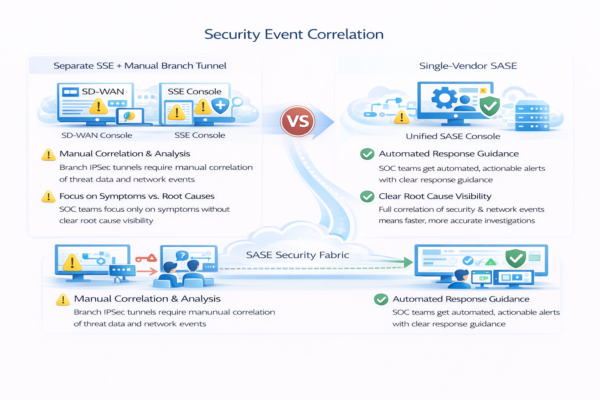
Using single-vendor SASE avoids the need for separate security event correlation.
- Investigations are faster and more accurate without the need to correlate events from two vendors
- Single-vendor agentic AI can give automated actionable alerts with clear response guidance with a single-vendor LLM
How does single-vendor SASE strengthen identity and segmentation?
Single-vendor SASE also enables comprehensive segmentation at device, application, and network levels – including blocking rogue IoT devices and enforcing Zero Trust principles across SSE gateways.
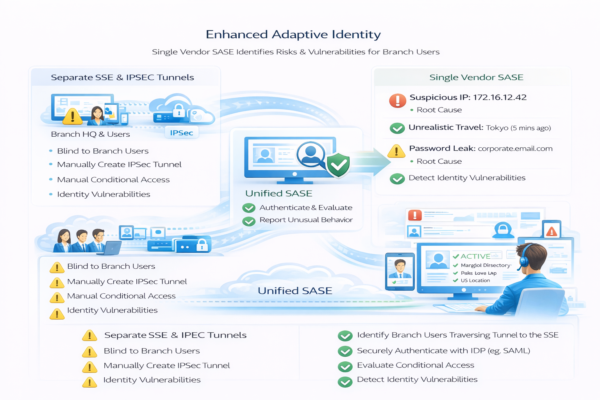
5. Enhanced adaptive identity
Using single-vendor SASE enhances adaptive identity.
- Two different vendors do not have the same view of users and they may need to reauthenticate at the SSE gateway
- SSE gateways configured to identify users by IP address may not have up to date assignments to map their security policies
- Identifying indicators of compromise like unrealistic travel becomes challenging
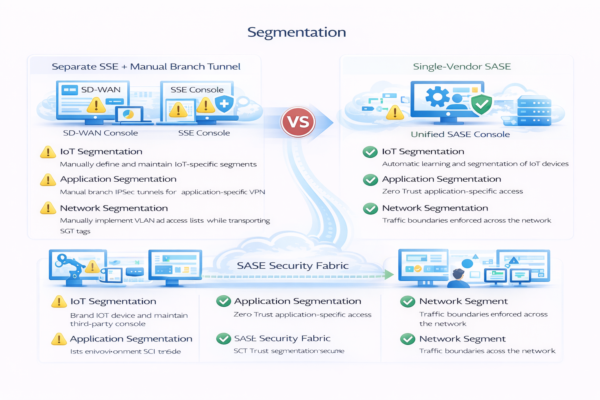
6. Segmentation
Using single-vendor SASE enables comprehensive segmentation.
- Enables device-level micro-segmentation action like blocking rogue IoT devices
- Enables application-level segmentation across flows through SSE gateways to enforce zero trust principles
- Enables network-level segmentation through transport and awareness of SGT tags
How does a unified architecture improve traffic steering and troubleshooting?
Single-vendor SASE also reduces troubleshooting time through unified network and security logs, removing manual investigations and the inefficiencies of working across multiple vendor support teams with conflicting perspectives.
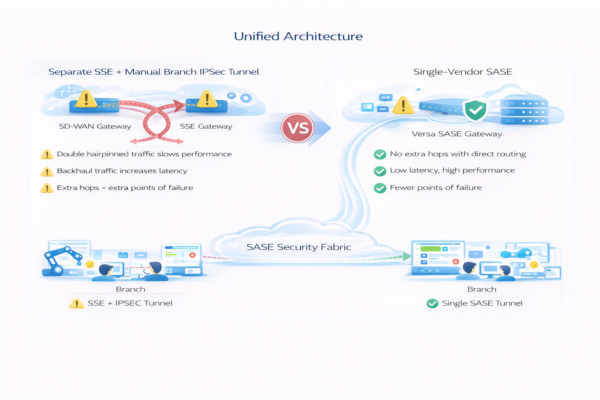
7. Unified architecture
Using single-vendor SASE improves traffic steering using a unified architecture.
- No traffic hair-pinning with direct routing between the network and SSE gateways
- No extra hops between traffic forwarding and security processing nodes to add latency, loss or jitter
- No extra latency from backhauled flows between clients and their destination
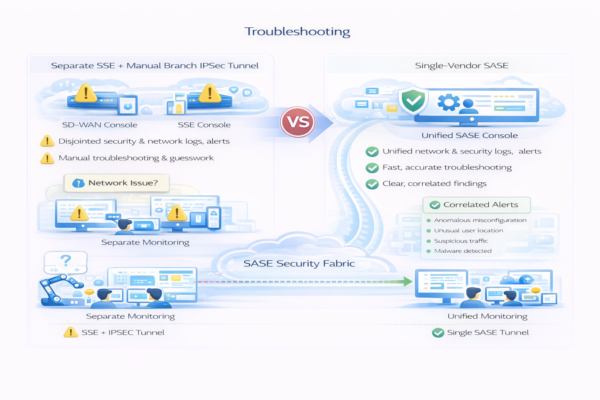
8. Troubleshooting
Using single-vendor SASE reduces troubleshooting time and effort.
- Teams work with a consistent view of their environment with unified network and security logs and alerts
- Teams eliminate time-intensive manual investigations and guesswork
- They avoid challenges and inefficiencies that derive from working with multiple vendor support teams with different perspectives
How does single-vendor SASE improve forwarding and routing performance?
Native capabilities include traffic shaping, policing, acceleration, QoS, forward error correction, packet cloning, and multipath load balancing with SLA monitoring.
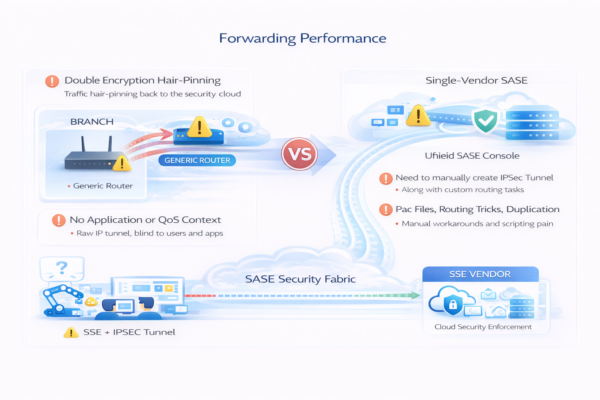
9. Forwarding performance
Using single-vendor SASE improves forwarding performance.
- It harnesses the full power of transport over SD-WAN in a way that manual IPsec tunnels do not provide, including traffic shaping, policing, acceleration, QoS, forward error correction, packet cloning, multipath load balancing with SLA monitoring , etc.
- Eliminates convoluted work-arounds to direct user traffic to SSE gateways with PAC files, routing tricks, and scripting
10. Resource routing
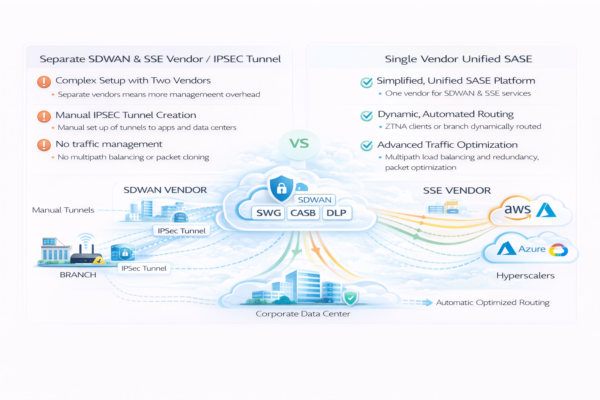
Using single-vendor SASE improves routing to target resources.
- SSE security processing gateways can dynamically learn routes and forward flows to data centers or hyperscalers
- Similar forwarding performance benefits over SD-WAN at the access leg that manual IPsec tunnels do not provide, including traffic shaping, policing, acceleration, QoS, forward error correction, packet cloning, multipath load balancing with SLA monitoring , etc.
How does VersaONE deliver Unified SASE?
VersaONE unifies policy control, embeds inline threat detection and response, funnels all telemetry into one data lake, and uses single-pass scanning to simplify maintenance and operate infrastructure more efficiently.
VersaONE provides security and networking in a centrally managed, converged platform.
- All network and security functions are controlled through one console and a single set of policies to manage, ensuring consistent policy configuration, management, and enforcement across customer’s entire networks.
- It provides embedded inline threat detection and response, data security, and filtering throughout the network, and continuously verifies the identity and security posture of every client, ensuring real-time defense.
- All security and network telemetry are funneled into one data lake, enabling comprehensive visibility and advanced analytics.
- Delivers high performance through a single-pass scanning architecture.
- Simplifies software maintenance, enabling organizations to operate their infrastructure more efficiently.
Summary
The benefits of single-vendor unified SASE are clear. Using a different vendor for SD-WAN and SSE equates to twice the effort in training, provisioning, management, troubleshooting, and correlating security events.
Validated by partners, providers, and customers, VersaONE single-vendor unified SASE eliminates the issues with using multiple vendors point products and delivers an optimal unified networking and security service.

Matthew Brooks brings more than 15 years in cybersecurity, cloud, and enterprise networking to his technical marketing work across Versa's SASE, SSE, SD-WAN, SD-LAN, and firewall products. He previously led product marketing for Cisco's Zero Trust and identity security portfolio, and held product and marketing roles at Verizon and Citrix.