This is Part 2 of our three-part series, Pervasive Security in the Age of AI: The New Paradigm. Here we turn from the problem to the architecture that solves it. Part 3 covers the business value it unlocks.
From Fragmentation to Unity
In the first post of this series, we made the case for the problem. The time-to-exploit has collapsed from years to hours, the patch window has effectively closed, and AI has widened the attack surface while accelerating the threat velocity at the same time. Most damaging of all, the typical enterprise still runs dozens of disconnected security tools that produce siloed telemetry, conflicting policies, and delayed enforcement. Fragmentation is the core failure, and it is the one attackers exploit every day.
This post turns from the problem to the blueprint. If the answer to gaps between tools cannot be another tool, then it has to be a different architecture.
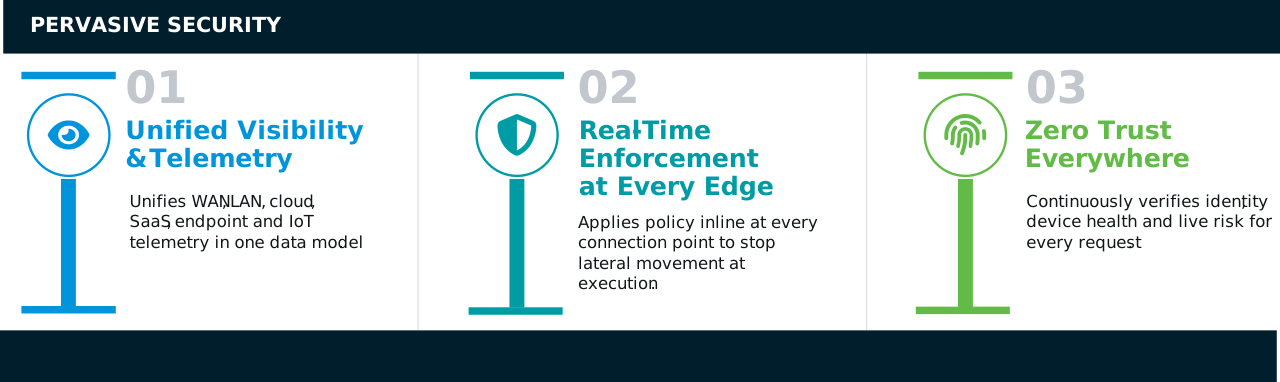
Pervasive Security is that architecture, and it rests on three pillars: unified visibility, real-time enforcement, and Zero Trust everywhere. Together they convert a collection of point products into a single, continuous defense.
Fragmented security tools are no match for AI-powered adversaries. To defend every user, device, and connection in real time, businesses need a unified approach that evolves with the threat landscape.
Analysts have already named the destination. Gartner’s Cybersecurity Mesh Architecture (CSMA), introduced by Neil MacDonald and colleagues, describes a composable model in which security tools interoperate and share intelligence rather than operate in isolation. Gartner projected that organizations adopting a mesh approach would reduce the average financial impact of individual security incidents by roughly 90% (Gartner, Top Strategic Technology Trends 2022). Pervasive Security is the realized version of that vision. It delivers mesh outcomes natively, on a single platform, instead of asking customers to stitch the mesh together across many vendors. The three pillars below are how Versa achieves those outcomes without paying the integration tax.
Pillar 1: Unified Visibility and Telemetry
You cannot protect what you cannot see, and fragmentation guarantees blind spots. Endpoint tools, network tools, and SaaS tools each watch their own slice of the environment, and attackers live in the seams between them: unmonitored APIs, shadow SaaS, and unmanaged devices. The cost of this sprawl is measurable. Large enterprises run 45 or more security tools on average and coordinate roughly 19 of them per incident, and organizations using 50 or more tools actually rated themselves about 8% worse at detecting and responding to attacks (IBM and Ponemon Institute). More consoles have meant more gaps, not more coverage.
What does unified visibility actually change?
Unified visibility consolidates telemetry across WAN, LAN, cloud, SaaS, endpoints, and IoT into one data model, so every interaction is observed in one place rather than reconstructed after the fact from a dozen logs. That single view is what makes fast detection possible. It matters because global median dwell time, the span an attacker operates inside a network before discovery, is still 11 days (Mandiant and Google, M-Trends 2025). When an insider threat surfaces inside a SaaS application or an agent starts moving data it should not touch, a unified model can flag the anomaly immediately instead of waiting for a quarterly correlation exercise. The VersaONE platform builds this visibility into the fabric itself, pairing it with digital experience monitoring so security and performance share the same source of truth.
Pillar 2: Real-Time Enforcement at Every Edge
Visibility alone is not enough. Seeing a threat a beat after it lands still leaves you a beat behind. Traditional, perimeter-based enforcement was built for a world where traffic flowed in and out of a defined boundary, and it is far too slow for distributed environments where attackers living off the land move laterally in minutes. The data is clear on where the danger lies. Ransomware was present in 44% of breaches, up 37% year over year, and it spreads east-west once it is inside (Verizon 2025 DBIR). East-west, or lateral, traffic is roughly 75% to 80% of all data-center traffic, far more than the north-south flows most perimeter tools watch (Cisco Global Cloud Index).
How does real-time enforcement stop an attack in motion?
In a Pervasive Security model, enforcement travels with the user session and the workload. Policy is applied inline at every connection point, the WAN edge, the SaaS path, the endpoint, the LAN, and the IoT segment, so a threat is blocked at the moment of execution rather than detected after damage is done. Picture ransomware that has already compromised one host and is reaching toward a file server. Inline enforcement on the internal path can recognize the lateral attempt and stop the propagation before it spreads, because the protection sits on the traffic itself. The same data plane that runs Versa’s Next-Generation Firewall also inspects GenAI traffic, so new AI-driven risk is an extension of existing policy rather than a new silo to manage.
Visibility without control is meaningless. Pervasive Security delivers both, everywhere.
Pillar 3: Zero Trust Everywhere
Implicit trust is the vulnerability that legacy models were built around. Overprivileged admin accounts, standing access, and compromised insider credentials all assume that being inside the network equals being trustworthy. That assumption no longer holds, and the machine side of the house makes it worse. Machine identities now outnumber humans by more than 80 to 1, and 42% of them carry privileged or sensitive access (CyberArk 2025 Identity Security Report). Most of these identities never face a login prompt, yet many can reach sensitive systems.
What does Zero Trust everywhere require?
Zero Trust means no user and no device is trusted by default, and every request is verified continuously using identity and device context. Policies are dynamic and adapt to user role, device health, and live risk signals, so valid credentials from a device behaving strangely can still be denied access to sensitive data. The gap between intent and reality here is large. Only about 10% of large enterprises will have a mature, measurable Zero Trust program by 2026, even though the vast majority have an initiative underway (Gartner). Gartner also warns that through 2026, more than half of cyberattacks will target areas that Zero Trust controls do not cover, which is exactly why Pervasive Security treats Zero Trust as a foundation pillar inside a broader architecture rather than the whole strategy. Versa operationalizes Zero Trust Everywhere on unified infrastructure, extending it to the LAN, OT, and IoT segments that cloud-only models leave uncovered.
Zero Trust means assuming no one and nothing is trustworthy until proven otherwise, every single time.
Beyond Technology: Simplifying Security Operations
A unified architecture is also an operational unlock, and the timing matters. Security teams are stretched thin: the global cybersecurity workforce gap reached 4.8 million, and 90% of organizations report a skills shortage (ISC2 2024 Workforce Study). Asking those teams to run 45 disconnected tools at AI speed is a losing proposition. The market knows it, which is why more than 75% of organizations are pursuing security vendor consolidation, up from 29% in 2020 (Gartner).
Pervasive Security answers this with a Platform of Platforms, a single console where teams deploy, manage, and scale policy across networking and security at once. Built-in automation handles the repetitive work, correlating signals, responding to anomalies, and applying policy, so analysts spend their time on judgment rather than on swivel-chair integration. Unified SASE is the delivery model that makes this practical at scale, collapsing the operational overhead that fragmentation created.
Pervasive Security at AI Speed: How the Pillars Work Together
The pillars are strongest in combination. Consider three representative situations that AI-era enterprises face every week.
- Polymorphic malware that rewrites itself to dodge signatures. Real-time enforcement inspects behavior inline and blocks the payload at execution, so a constantly changing signature never gets the chance to detonate. This is Pillar 2 doing the work.
- Shadow SaaS and GenAI data leakage that looks like productivity. Unified visibility surfaces the unsanctioned application and the sensitive data flowing into it, turning an invisible risk into a governed one. This is Pillar 1 closing a blind spot.
- Lateral movement after a single credential is compromised. Zero Trust verification plus inline east-west enforcement denies the next hop even though the credential is valid, containing the incident to one host. This is Pillars 2 and 3 in concert.
Building an AI-Resilient Security Framework
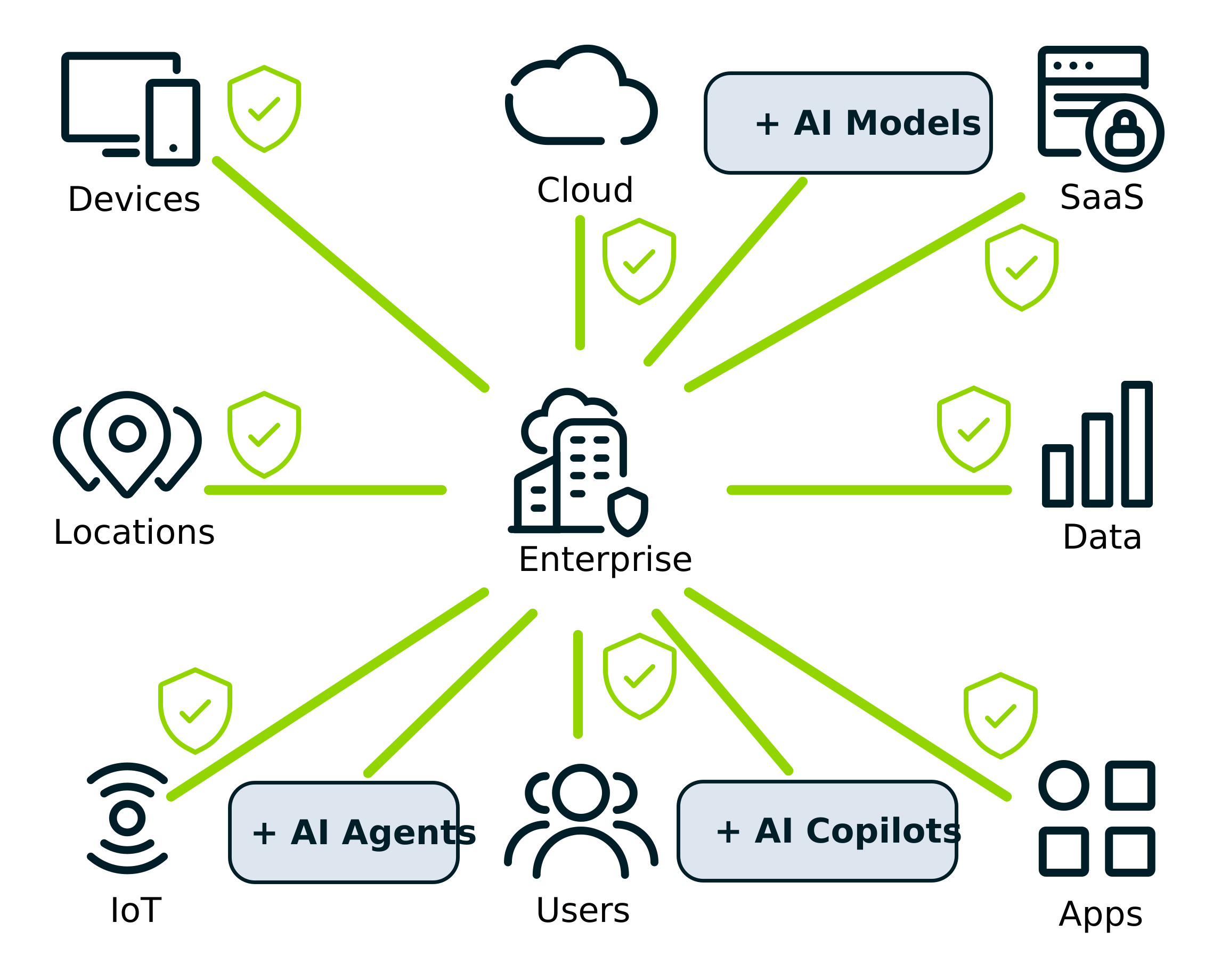
Unified visibility, real-time enforcement, and Zero Trust everywhere are not three products to buy. They are three properties of one architecture, and they only deliver their full value when they run on the same platform, the same policy engine, and the same data. That is the foundation Pervasive Security provides, and it is what makes an enterprise resilient at the speed attackers now operate.
In Part 3, we move from the how to the why it pays. We will show how this architecture converts into business outcomes: speed, simplicity, and total control, and how to measure the return.
The tools and strategies of yesterday cannot defend against the threats of today. The Pervasive Security framework is the future of defense: unified, proactive, and built for AI speed.